---
title: "Event Analysis"
subtitle: "Run Theory for Climate Extremes"
author: "Benny Istanto"
date: last-modified
execute:
eval: true
echo: true
warning: false
cache: true
format:
html:
code-fold: show
code-tools: true
---
## Overview
This tutorial demonstrates **run theory** (Yevjevich, 1967) for identifying and analyzing climate extreme events --- both droughts and wet extremes --- using real TerraClimate data from Bali, Indonesia (1950-2025).
**What is Run Theory?**
Run theory provides a systematic approach to analyzing climate extremes:
- **Events** are identified when SPI/SPEI crosses a threshold
- **Duration (D)**: How long the event lasts (months)
- **Magnitude (M)**: Cumulative deficit/surplus below/above threshold
- **Intensity (I)**: Average severity = M / D
- **Peak (P)**: Most extreme value during event
- **Inter-arrival (T)**: Time between successive events
This goes beyond simple threshold exceedance by capturing the full evolution of events.
**What you'll learn:**
1. Load previously calculated SPI data
2. Visualize SPI with threshold lines
3. Identify drought events using run theory
4. Analyze event characteristics (duration, magnitude, intensity, peak)
5. Identify and compare wet events
6. Time-series monitoring (month-by-month evolution)
7. Understand dual magnitude (cumulative vs instantaneous)
8. Calculate gridded period statistics for spatial analysis
9. Export events to CSV and NetCDF
**Three Modes of Analysis:**
| Mode | Function | Use Case | Output |
|:--|:--|:--|:--|
| Event-Based | `identify_events()` | Historical analysis | DataFrame of events |
| Time-Series | `calculate_timeseries()` | Real-time monitoring | DataFrame by month |
| Period Stats | `calculate_period_statistics()` | Decision support | Gridded statistics |
## 1. Setup and Imports
```{python}
import sys
import os
from pathlib import Path

# Get the notebook directory and find the repository root
notebook_dir = Path.cwd()
repo_root = notebook_dir
while not (repo_root / 'src').exists() and repo_root != repo_root.parent:
    repo_root = repo_root.parent

# Add src to path
src_path = str(repo_root / 'src')
if src_path not in sys.path:
    sys.path.insert(0, src_path)

import numpy as np
import xarray as xr
import pandas as pd
import matplotlib.pyplot as plt
from datetime import datetime

# Import event analysis functions
from runtheory import (
    identify_events,
    calculate_timeseries,
    calculate_period_statistics,
    summarize_events
)

# Import visualization functions
from visualization import (
    plot_index,
    plot_events,
    plot_event_timeline
)

# Plotting settings
plt.rcParams['figure.figsize'] = (14, 6)
plt.rcParams['font.size'] = 10

# Create output directories
output_plots = repo_root / 'output' / 'plots'
output_netcdf = repo_root / 'output' / 'netcdf'
output_csv = repo_root / 'output' / 'csv'
output_plots.mkdir(parents=True, exist_ok=True)
output_netcdf.mkdir(parents=True, exist_ok=True)
output_csv.mkdir(parents=True, exist_ok=True)

print("All imports successful!")
print(f"Repository root: {repo_root}")
```
## 2. Load SPI-12 Data
Load previously calculated SPI-12 data from [Tutorial 01](01-calculate-spi.qmd).
```{python}
# Load SPI-12
spi_file = repo_root / 'output' / 'netcdf' / 'spi_12_bali.nc'

ds = xr.open_dataset(spi_file)
spi_12 = ds['spi_gamma_12_month']

print("SPI-12 loaded successfully!")
print(f"\nDataset Information:")
print(f"  Shape: {spi_12.shape}")
print(f"  Dimensions: {spi_12.dims}")
print(f"  Time range: {spi_12.time[0].values} to {spi_12.time[-1].values}")
print(f"  Spatial extent: {len(spi_12.lat)} x {len(spi_12.lon)} grid (Bali, Indonesia)")
print(f"  Lat range: {float(spi_12.lat.min()):.2f} to {float(spi_12.lat.max()):.2f}")
print(f"  Lon range: {float(spi_12.lon.min()):.2f} to {float(spi_12.lon.max()):.2f}")
```
## 3. Select Sample Location
For event-based and time-series analysis, extract a single location in central Bali.
```{python}
# Select center of Bali
lat_idx = len(spi_12.lat) // 2
lon_idx = len(spi_12.lon) // 2

# Extract location
spi_loc = spi_12.isel(lat=lat_idx, lon=lon_idx)
lat_val = float(spi_12.lat.values[lat_idx])
lon_val = float(spi_12.lon.values[lon_idx])

print(f"Selected location: {lat_val:.2f}, {lon_val:.2f} (Central Bali)")
print(f"SPI time series length: {len(spi_loc)} months ({len(spi_loc)/12:.1f} years)")
print(f"Mean SPI: {float(spi_loc.mean()):.3f}")
print(f"Std SPI: {float(spi_loc.std()):.3f}")
```
### Visualize SPI-12 Time Series
```{python}
fig, ax = plt.subplots(figsize=(14, 5))
spi_loc.plot(ax=ax, linewidth=0.8, color='steelblue')
ax.axhline(y=0, color='k', linestyle='-', linewidth=0.8, alpha=0.3)
ax.axhline(y=-1.2, color='red', linestyle='--', linewidth=0.8, alpha=0.5, label='Dry threshold -1.2')
ax.axhline(y=1.2, color='blue', linestyle='--', linewidth=0.8, alpha=0.5, label='Wet threshold +1.2')
ax.fill_between(spi_loc.time, -5, 0, alpha=0.1, color='red', label='Dry')
ax.fill_between(spi_loc.time, 0, 5, alpha=0.1, color='blue', label='Wet')
ax.set_ylim(-3, 3)
ax.set_title(f'SPI-12 at {lat_val:.2f}, {lon_val:.2f} (Central Bali, 1950-2025)')
ax.set_ylabel('SPI-12')
ax.legend()
ax.grid(True, alpha=0.3)
plt.tight_layout()
plt.show()
```
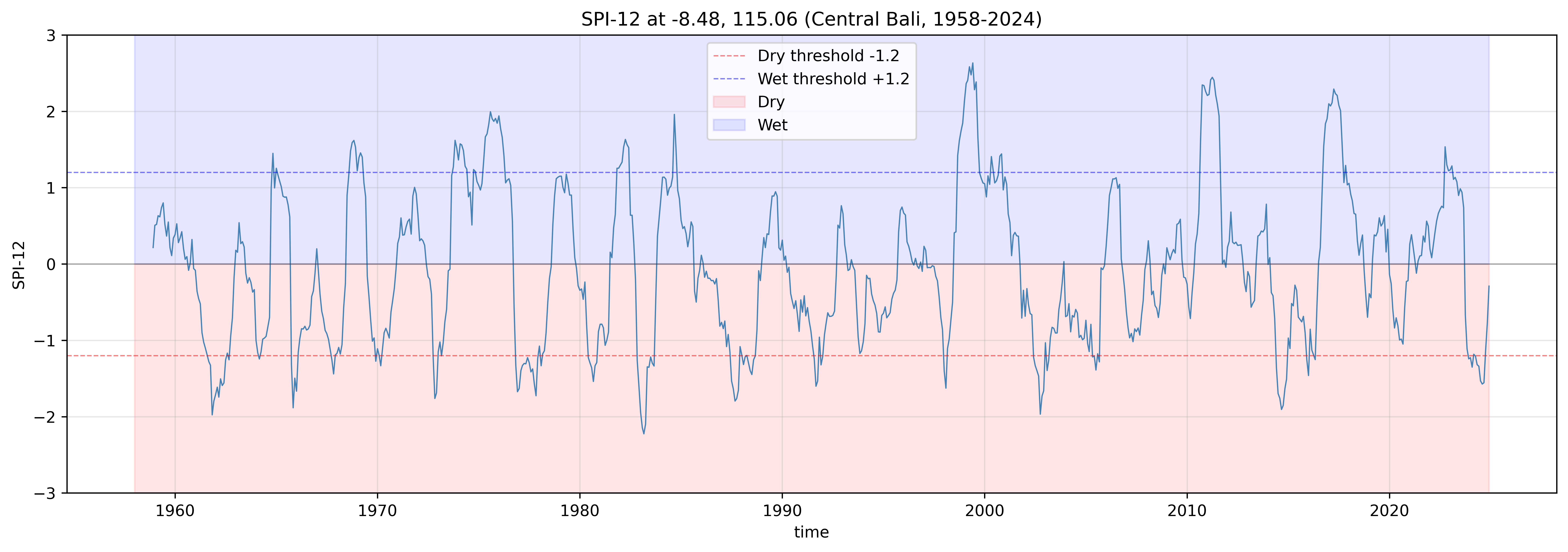
The dashed lines at +-1.2 mark the thresholds for identifying moderate drought and wet events. Periods below -1.2 are drought events; periods above +1.2 are wet events.
## 4. Mode 1: Event-Based Analysis (Dry Events)
Identify complete dry events using run theory. Each event is characterized by duration, magnitude, intensity, peak, and inter-arrival time.
```{python}
# Identify dry events (drought)
threshold_dry = -1.2  # Moderate dry threshold
min_duration = 3  # Minimum 3 months to be considered an event

print(f"Identifying dry events with:")
print(f"  Threshold: {threshold_dry}")
print(f"  Minimum duration: {min_duration} months")
print()

events_dry = identify_events(spi_loc, threshold=threshold_dry, min_duration=min_duration)

print(f"Found {len(events_dry)} dry events")
print()
print("Dry Event Summary:")
print(events_dry[['start_date', 'end_date', 'duration', 'magnitude', 'intensity', 'peak']])
```
::: {.callout-note}
### Threshold Selection
Common thresholds for SPI/SPEI event analysis:
- **-0.7:** Mild drought (more events, less severe)
- **-1.0:** Moderate drought (WMO recommendation)
- **-1.2:** Significant drought (used in this example)
- **-1.5:** Severe drought (fewer but more intense events)
:::
### Dry Event Statistics
```{python}
# Summarize dry events
summary_dry = summarize_events(events_dry)

print("Dry Event Statistics:")
print("=" * 50)
print(f"Total events: {summary_dry['num_events']}")
print(f"Mean duration: {summary_dry['mean_duration']:.1f} months")
print(f"Max duration: {summary_dry['max_duration']} months")
print(f"Mean magnitude: {summary_dry['mean_magnitude']:.2f}")
print(f"Max magnitude: {summary_dry['max_magnitude']:.2f}")
print(f"Most severe peak: {summary_dry['most_severe_peak']:.2f}")
print(f"Mean inter-arrival: {summary_dry['mean_interarrival']:.1f} months")
```
### Visualize Dry Events
```{python}
fig = plot_events(spi_loc, events_dry, threshold=threshold_dry,
                  title=f'Dry Events at {lat_val:.2f}, {lon_val:.2f} (Bali, 1950-2025)')
plt.tight_layout()
plt.show()
```
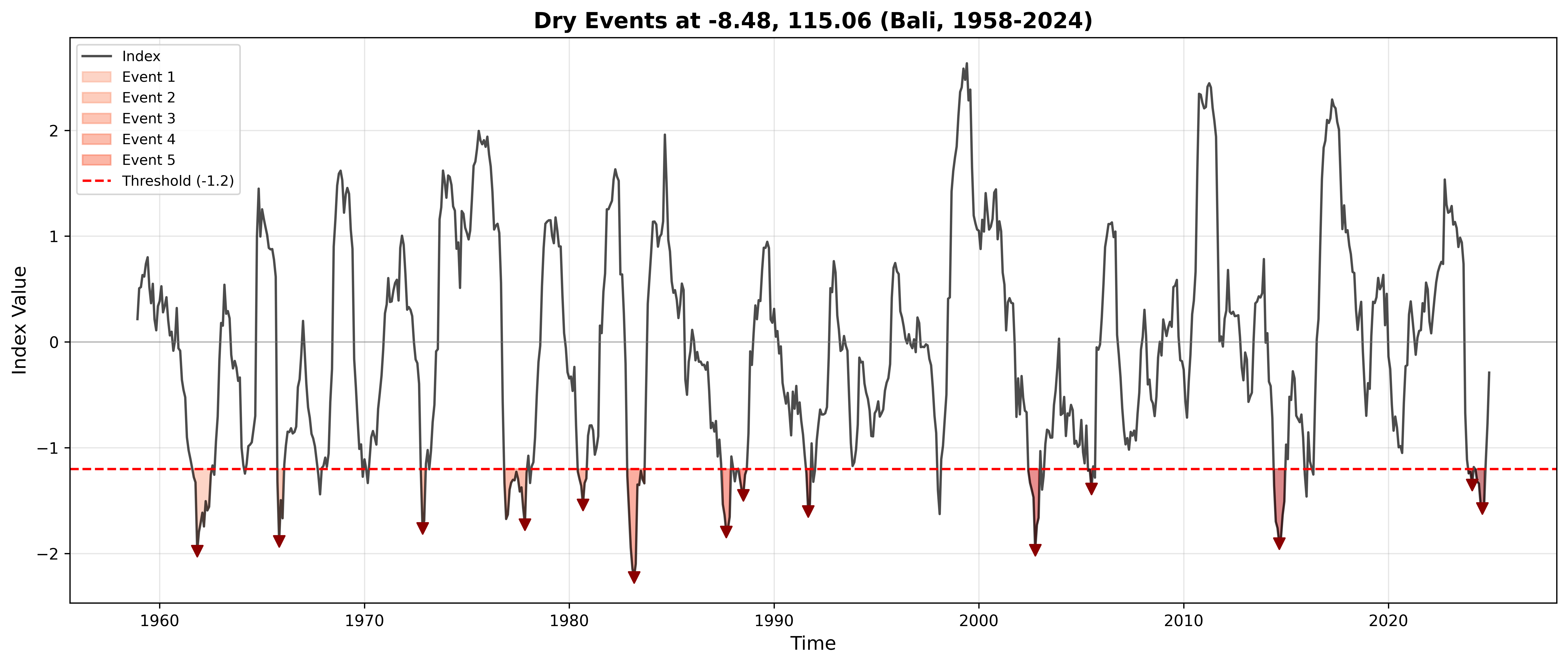
Drought events are highlighted in the time series. Each shaded region represents a complete event that exceeded the threshold for at least 3 consecutive months.
## 5. Wet Events Analysis
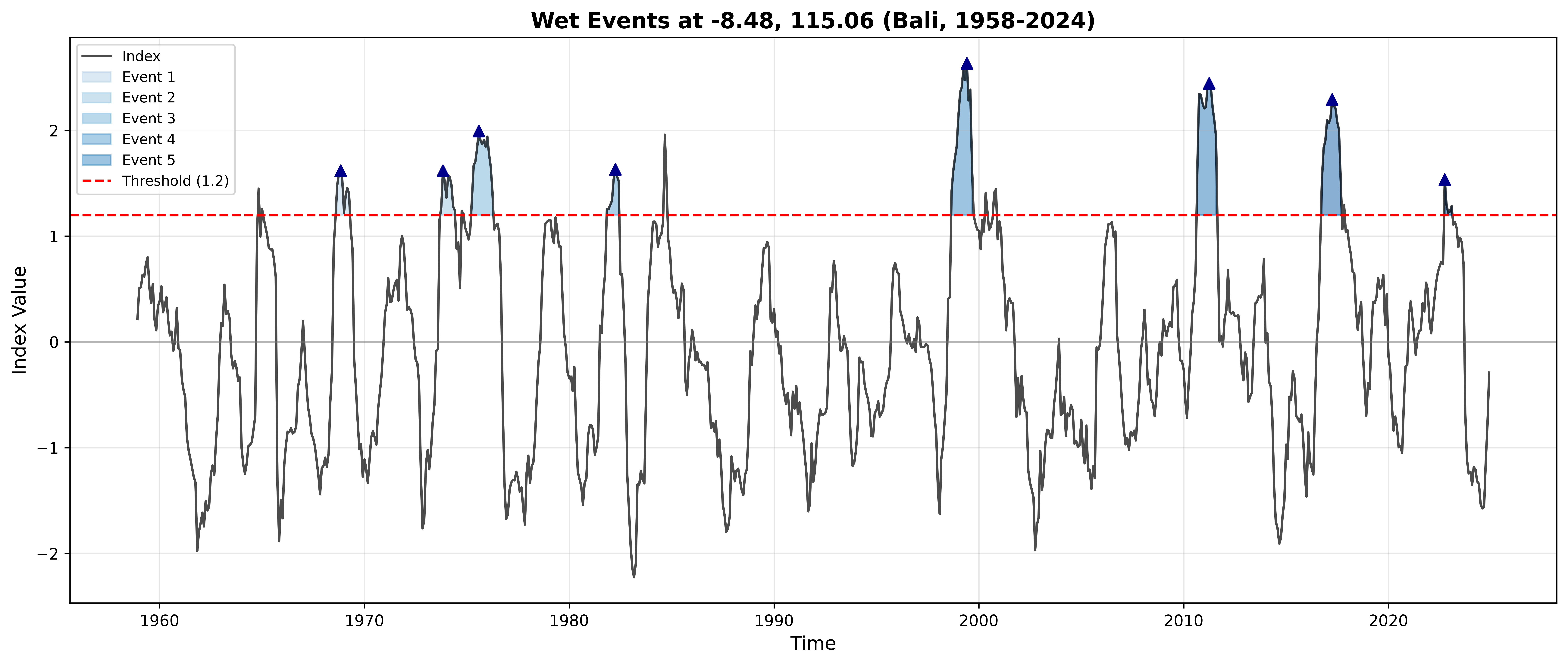
The same functions work for wet events --- just use a positive threshold.
```{python}
# Identify wet events
threshold_wet = 1.2  # Moderate wet threshold (positive!)

print(f"Identifying wet events with:")
print(f"  Threshold: {threshold_wet}")
print(f"  Minimum duration: {min_duration} months")
print()

events_wet = identify_events(spi_loc, threshold=threshold_wet, min_duration=min_duration)

print(f"Found {len(events_wet)} wet events")
print()
print("Wet Event Summary:")
print(events_wet[['start_date', 'end_date', 'duration', 'magnitude', 'intensity', 'peak']])
```
### Wet Event Statistics
```{python}
summary_wet = summarize_events(events_wet)

print("Wet Event Statistics:")
print("=" * 50)
print(f"Total events: {summary_wet['num_events']}")
print(f"Mean duration: {summary_wet['mean_duration']:.1f} months")
print(f"Max duration: {summary_wet['max_duration']} months")
print(f"Mean magnitude: {summary_wet['mean_magnitude']:.2f}")
print(f"Max magnitude: {summary_wet['max_magnitude']:.2f}")
print(f"Most extreme peak: {summary_wet['most_severe_peak']:.2f}")
print(f"Mean inter-arrival: {summary_wet['mean_interarrival']:.1f} months")
```
### Visualize Wet Events
```{python}
fig = plot_events(spi_loc, events_wet, threshold=threshold_wet,
                  title=f'Wet Events at {lat_val:.2f}, {lon_val:.2f} (Bali, 1950-2025)')
plt.tight_layout()
plt.show()
```
### Compare Dry vs Wet Events
```{python}
# Comparison summary
print("=" * 50)
print("Comparison: Dry vs Wet Events")
print("=" * 50)
print(f"Dry events: {summary_dry['num_events']:.0f}  |  Wet events: {summary_wet['num_events']:.0f}")
print(f"Dry avg duration: {summary_dry['mean_duration']:.1f} months  |  Wet avg duration: {summary_wet['mean_duration']:.1f} months")
print(f"Dry avg magnitude: {summary_dry['mean_magnitude']:.2f}  |  Wet avg magnitude: {summary_wet['mean_magnitude']:.2f}")

# Visualize comparison
fig, (ax1, ax2) = plt.subplots(1, 2, figsize=(14, 5))

# Duration comparison
ax1.hist(events_dry['duration'], bins=15, alpha=0.7, label='Drought', color='orange')
ax1.hist(events_wet['duration'], bins=15, alpha=0.7, label='Wet', color='blue')
ax1.set_xlabel('Duration (months)')
ax1.set_ylabel('Frequency')
ax1.set_title('Event Duration Distribution')
ax1.legend()
ax1.grid(True, alpha=0.3)

# Magnitude comparison
ax2.hist(events_dry['magnitude'], bins=15, alpha=0.7, label='Drought', color='orange')
ax2.hist(events_wet['magnitude'], bins=15, alpha=0.7, label='Wet', color='blue')
ax2.set_xlabel('Magnitude')
ax2.set_ylabel('Frequency')
ax2.set_title('Event Magnitude Distribution')
ax2.legend()
ax2.grid(True, alpha=0.3)

plt.tight_layout()
plt.show()
```
::: {.callout-important}
### Bidirectional Analysis
The same functions work for both extremes:
- **Droughts:** negative thresholds (e.g., -1.2)
- **Wet events:** positive thresholds (e.g., +1.2)
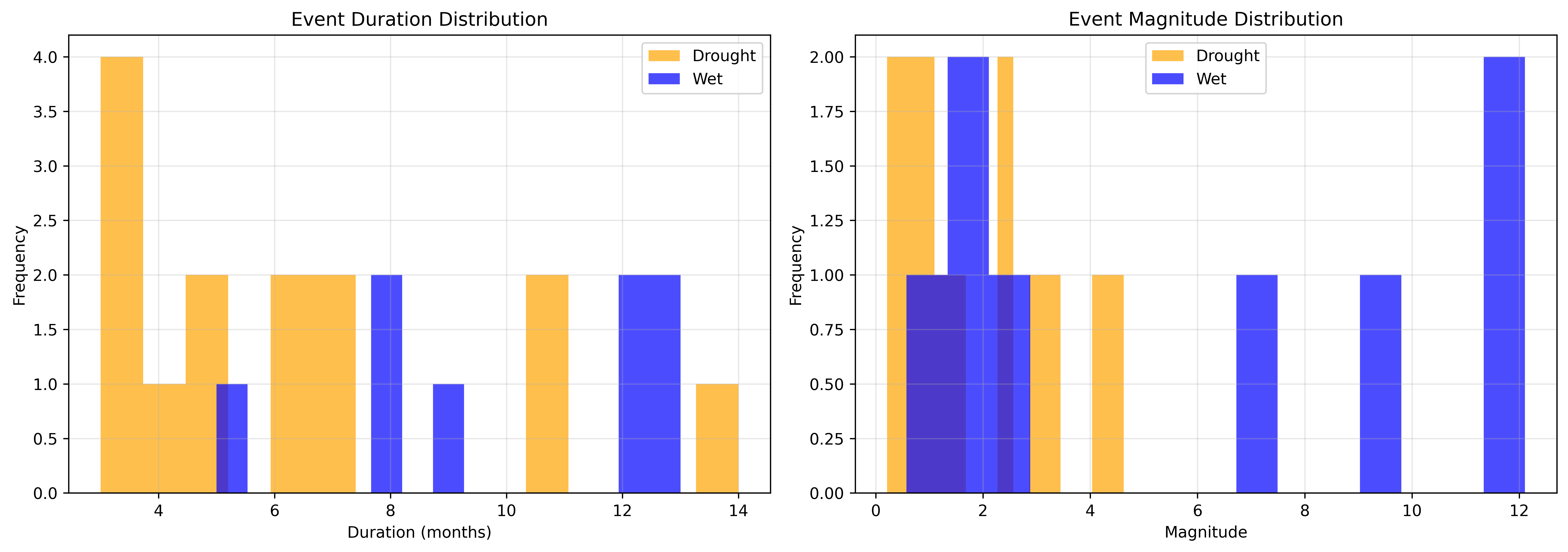
This unified framework makes analysis consistent and reproducible.
:::
## 6. Mode 2: Time-Series Monitoring
Calculate month-by-month characteristics for real-time monitoring. This mode tracks the evolution of events as they unfold --- useful for operational systems.
```{python}
# Calculate dry event time series
print("Calculating dry event time series...")
ts_dry = calculate_timeseries(spi_loc, threshold=threshold_dry)

print(f"Time series calculated")
print(f"  Length: {len(ts_dry)} months")
print(f"  Columns: {list(ts_dry.columns)}")
```
### Current Status Check
```{python}
# Check current status (last month in data)
current = ts_dry.iloc[-1]

print("Current Status (Latest Data):")
print("=" * 50)
print(f"Date: {ts_dry.index[-1]}")
print(f"SPI-12: {current['index_value']:.2f}")

if current['is_event']:
    print(f"\nDRY EVENT IN PROGRESS")
    print(f"  Event ID: {current['event_id']}")
    print(f"  Duration: {current['duration']} months")
    print(f"  Cumulative magnitude: {current['magnitude_cumulative']:.2f}")
    print(f"  Current severity: {current['magnitude_instantaneous']:.2f}")
    print(f"  Intensity: {current['intensity']:.2f}")
else:
    print(f"\nNO DRY EVENT - Normal conditions")
```
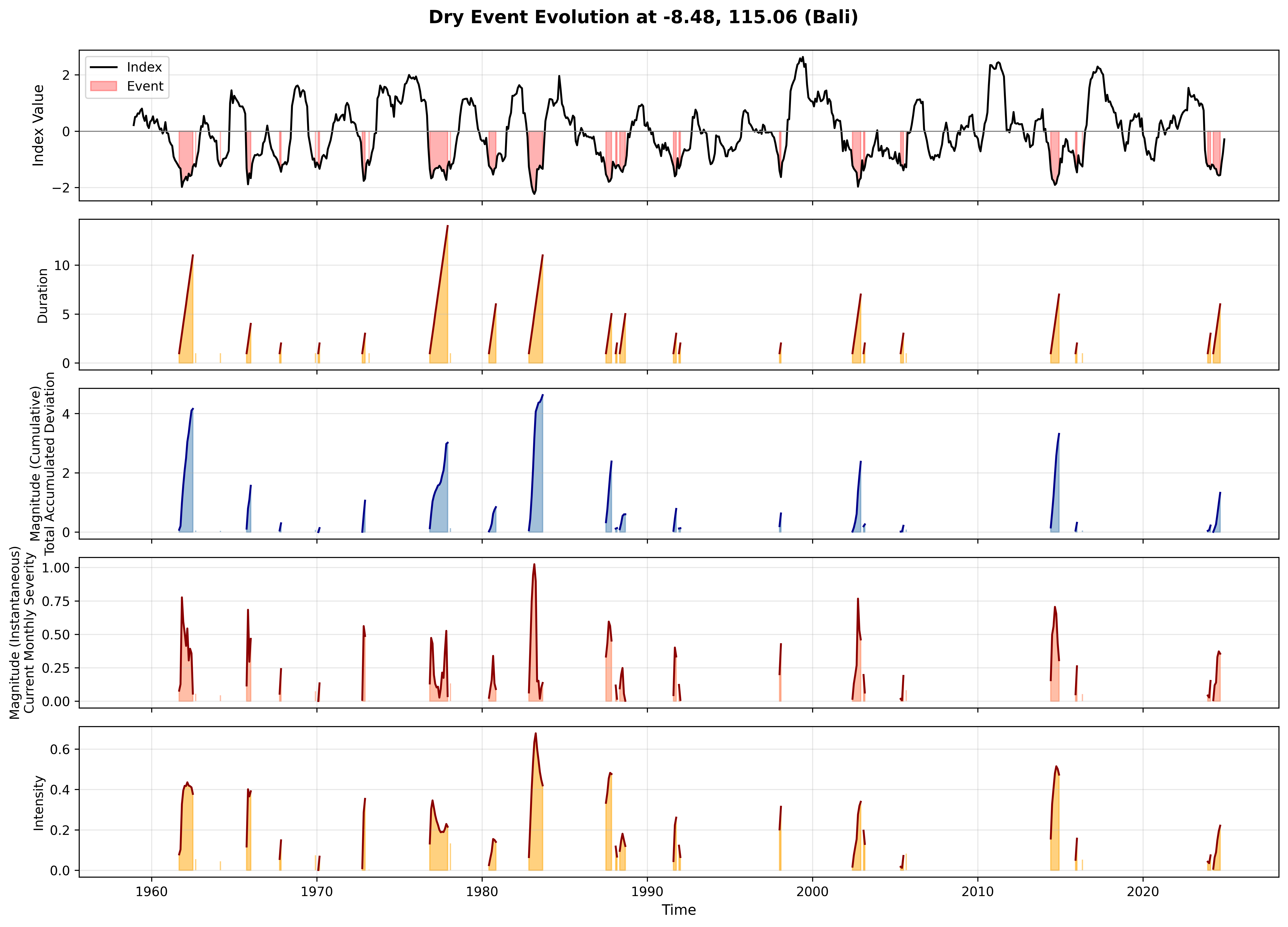
### Event Evolution Timeline (5-Panel Plot)
The 5-panel event timeline shows:
1. Index value (SPI-12)
2. Duration (months)
3. Cumulative magnitude (total deficit, always increasing during event)
4. Instantaneous magnitude (current severity, varies within event)
5. Intensity (average severity)
```{python}
fig = plot_event_timeline(ts_dry)

# Customize title
axes = fig.get_axes()
axes[0].set_title('')
fig.suptitle(f'Dry Event Evolution at {lat_val:.2f}, {lon_val:.2f} (Bali)',
             fontsize=14, fontweight='bold', y=0.995)
plt.subplots_adjust(top=0.97)
plt.tight_layout()
plt.show()
```

### Magnitude Comparison: Cumulative vs Instantaneous
Two types of magnitude provide different insights:
- **Cumulative (blue)**: Total deficit, monotonically increases during event --- like debt accumulation
- **Instantaneous (red)**: Current severity, varies with SPI pattern --- like NDVI crop phenology
```{python}
fig, (ax1, ax2) = plt.subplots(2, 1, figsize=(14, 8), sharex=True)

# Get event mask
event_mask = ts_dry['is_event']

# Cumulative magnitude
cumulative_event = ts_dry['magnitude_cumulative'].where(event_mask)
ax1.fill_between(ts_dry.index, 0, cumulative_event,
                 alpha=0.4, color='steelblue', label='Cumulative')
ax1.plot(ts_dry.index, cumulative_event,
         color='darkblue', linewidth=1.5)
ax1.set_ylabel('Cumulative Magnitude', fontsize=11)
ax1.set_title('Cumulative Magnitude (Total Deficit - Always Increasing)', fontsize=12)
ax1.set_ylim(bottom=0)
ax1.legend()
ax1.grid(True, alpha=0.3)

# Instantaneous magnitude
instantaneous_event = ts_dry['magnitude_instantaneous'].where(event_mask)
ax2.fill_between(ts_dry.index, 0, instantaneous_event,
                 alpha=0.4, color='coral', label='Instantaneous')
ax2.plot(ts_dry.index, instantaneous_event,
         color='darkred', linewidth=1.5)
ax2.set_ylabel('Instantaneous Magnitude', fontsize=11)
ax2.set_xlabel('Time', fontsize=11)
ax2.set_title('Instantaneous Magnitude (Current Severity - Varies Within Event)', fontsize=12)
ax2.set_ylim(bottom=0)
ax2.legend()
ax2.grid(True, alpha=0.3)

plt.suptitle('Dual Magnitude Comparison - Dry Events (Bali)', fontsize=14, y=0.995)
plt.tight_layout()
plt.show()
```
The cumulative magnitude grows throughout each event, showing total accumulated deficit. The instantaneous magnitude shows current severity at each timestep --- it can increase or decrease as the drought intensifies or eases within a single event.
## 7. Mode 3: Period Statistics (Gridded)
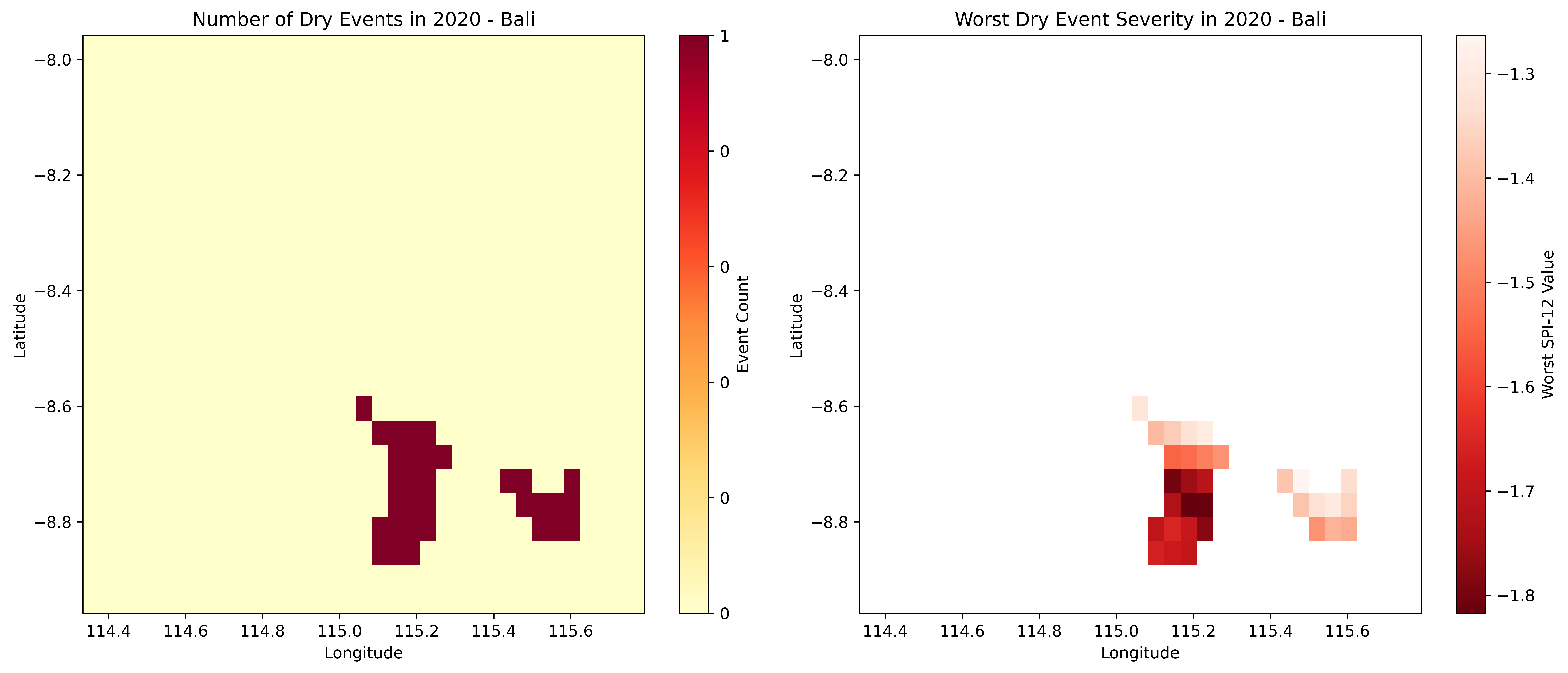
Calculate spatial statistics for specific time periods across all grid cells. This answers decision-maker questions like:
- "How many drought events occurred in 2020?"
- "Where was the worst drought in the last 5 years?"
- "What percentage of time was each area in drought?"
### Single-Year Statistics (2020)
```{python}
print("Calculating dry event statistics for 2020...")
stats_2020 = calculate_period_statistics(spi_12, threshold=threshold_dry,
                                          start_year=2020, end_year=2020,
                                          min_duration=min_duration)

print(f"Statistics calculated")
print(f"  Variables: {list(stats_2020.data_vars)}")
```
```{python}
# Plot number of events and worst severity
fig, (ax1, ax2) = plt.subplots(1, 2, figsize=(14, 6))

stats_2020['num_events'].plot(ax=ax1, cmap='YlOrRd',
                               cbar_kwargs={'label': 'Event Count', 'format': '%d'})
ax1.set_title('Number of Dry Events in 2020 - Bali', fontsize=12)
ax1.set_xlabel('Longitude')
ax1.set_ylabel('Latitude')

stats_2020['worst_peak'].plot(ax=ax2, cmap='Reds_r',
                               cbar_kwargs={'label': 'Worst SPI-12 Value'})
ax2.set_title('Worst Dry Event Severity in 2020 - Bali', fontsize=12)
ax2.set_xlabel('Longitude')
ax2.set_ylabel('Latitude')

plt.tight_layout()
plt.show()
```

### Multi-Year Statistics (2020--2025)
```{python}
print("Calculating dry event statistics for 2020-2025...")
stats_5yr = calculate_period_statistics(spi_12, threshold=threshold_dry,
                                         start_year=2020, end_year=2025,
                                         min_duration=min_duration)

print(f"5-year statistics calculated")
print(f"  Variables: {list(stats_5yr.data_vars)}")
```
```{python}
# 2x2 panel of key statistics
fig, axes = plt.subplots(2, 2, figsize=(16, 12))

variables = ['num_events', 'worst_peak', 'total_magnitude', 'pct_time_in_event']
titles = ['Event Count', 'Worst Severity (Most Negative SPI)', 'Total Magnitude', '% Time in Dry Event']
cmaps = ['YlOrRd', 'Reds_r', 'YlOrRd', 'Reds']

for ax, var, title, cmap in zip(axes.flat, variables, titles, cmaps):
    if var == 'num_events':
        cbar_kwargs = {'label': title, 'format': '%d'}
    elif var == 'pct_time_in_event':
        cbar_kwargs = {'label': title, 'format': '%.0f'}
    else:
        cbar_kwargs = {'label': title}

    stats_5yr[var].plot(ax=ax, cmap=cmap, cbar_kwargs=cbar_kwargs)
    ax.set_title(title, fontsize=12)
    ax.set_xlabel('Longitude')
    ax.set_ylabel('Latitude')

plt.suptitle('Dry Event Statistics Summary - Bali (2020-2025)', fontsize=14, y=0.995)
plt.tight_layout()
plt.show()
```
The four-panel summary shows: (1) how many drought events occurred, (2) the worst severity reached, (3) the total cumulative magnitude across all events, and (4) the percentage of time each grid cell spent in drought. Areas with higher values in all panels are the most drought-prone.
## 8. Export Results
Save events to CSV and statistics to NetCDF for further analysis.
```{python}
# Save drought events
events_dry.to_csv(output_csv / 'drought_events_bali.csv', index=False)
print(f"Drought events saved to: {output_csv / 'drought_events_bali.csv'}")

# Save wet events
events_wet.to_csv(output_csv / 'wet_events_bali.csv', index=False)
print(f"Wet events saved to: {output_csv / 'wet_events_bali.csv'}")

# Save time series
ts_dry.to_csv(output_csv / 'drought_timeseries_bali.csv')
print(f"Time series saved to: {output_csv / 'drought_timeseries_bali.csv'}")

# Save gridded statistics
stats_5yr.to_netcdf(str(output_netcdf / 'dry_stats_2020-2025_bali.nc'))
print(f"Gridded statistics saved to: {output_netcdf / 'dry_stats_2020-2025_bali.nc'}")
```
## 9. Summary
### Key Takeaways
1. **Run theory** provides a systematic framework for identifying complete extreme events with duration, magnitude, intensity, and peak characteristics
2. **Bidirectional analysis**: The same functions work for both drought (negative threshold) and wet events (positive threshold)
3. **Three analysis modes** serve different purposes: event-based (historical), time-series (monitoring), and period statistics (decision support)
4. **Dual magnitude**: Cumulative tracks total accumulated deficit; instantaneous tracks current severity
5. **Gridded statistics** enable spatial analysis of drought-prone areas
### Best Practices
| Parameter | Recommendation |
|:--|:--|
| Threshold | +-1.0 or +-1.2 for operational monitoring |
| Min duration | 3 months for SPI-12 (captures sustained events) |
| Period statistics | Use specific time windows for targeted questions |
| Both extremes | Analyze both dry and wet for a complete picture |
## Next Steps
- **[Visualization Gallery](04-visualization.qmd)** - Create publication-quality figures
- **[User Guide - Run Theory](../user-guide/runtheory.qmd)** - Detailed methodology
## References
- Yevjevich, V. (1967): An objective approach to definitions and investigations of continental hydrologic droughts
- McKee et al. (1993): SPI methodology