Validation & Test Results
Verifying SPI/SPEI output quality across distributions and configurations
This page presents validation results from the precip-index test suite, run against TerraClimate v1.1 monthly data for Bali, Indonesia (1950–2025). Each test verifies that the package produces statistically sound drought and wet-spell indices across multiple probability distributions.
About the Test Dataset
Why Bali, Indonesia?
Bali was selected as the validation region for several reasons that make it ideal for testing drought indices:
Tropical Monsoon Climate — Bali has a distinct wet season (November–March) and dry season (April–October), providing clear seasonal precipitation variability essential for SPI/SPEI validation.
Strong ENSO Signal — The island is sensitive to El Niño-Southern Oscillation (ENSO) events, and the 1997-98 strong El Niño drought is clearly present in the record, giving a known event to validate against. See Table 2 for the episodes the package actually resolves, which do not map one-to-one onto the ENSO record.
Diverse Topography — Elevation ranges from sea level to >3,000m (Mt. Agung), creating orographic rainfall gradients. This tests the package’s ability to handle spatial variability within a small domain.
Manageable Size — The ~5,780 km² island provides enough grid cells (319 land cells) for meaningful spatial statistics while keeping computation times reasonable for testing.
Long Climate Record — TerraClimate v1.1 reaches back to 1950, giving a 76-year record for drought trends and decadal variability.
Test Data Specifications
| Parameter | Value |
|---|---|
| Source | TerraClimate monthly gridded climate data, version 1.1 (WorldClim v2.1 + ERA5) |
| Domain | Bali, Indonesia (114.35–115.77°E, 7.98–8.94°S) |
| Resolution | ~4 km (1/24°) |
| Grid Size | 24 × 35 cells (840 total, 319 land cells) |
| Time Period | January 1950 – December 2025 (912 months, 76 years) |
| Land Coverage | 38.0% of grid cells |
| Temporal Completeness | 100% for all land cells |
Everything on this page was regenerated from TerraClimate v1.1. The previous results used v1.0, which drew on CRU Ts4.0 and JRA-55; v1.1 uses WorldClim v2.1 and ERA5. Over the identical Bali domain and the identical 1958–2024 span, only 0.1% of monthly precipitation values are unchanged between the two, and the mean absolute difference is 44.4 mm/month.
The temperatures moved more than the rainfall. Mean temperature is almost untouched (+0.34%), but tmin rose 5.4% and tmax fell 3.1%, narrowing the mean diurnal range from 9.38°C to 7.42°C, a 21% reduction. Hargreaves PET scales with the square root of that range, so it is the figure most affected by the version change. Thornthwaite, which uses only mean temperature, is barely affected.
The indices moved accordingly. Recomputing on v1.0 and v1.1 with identical code and comparing over the shared 1958-2024 months, correlation between the two versions is r = 0.71 to 0.76 for every SPI and SPEI variant, mean absolute difference is 0.52 to 0.66 index units, and 60 to 69% of cell-months change WMO class. PET splits as the diurnal range predicts: Thornthwaite moves 5.6 mm/month (r = 0.97), Hargreaves 14.8 mm/month (r = 0.85).
Do not compare numbers on this page against a v1.0 run and read the difference as a code change.
Available Variables
The test suite uses five TerraClimate variables:
| Variable | Description | Units | Mean | Range |
|---|---|---|---|---|
| ppt | Precipitation | mm/month | 157.3 | 0.0 – 943.7 |
| tmean | Mean temperature | °C | 24.6 | 14.6 – 30.0 |
| tmin | Minimum temperature | °C | 20.9 | 10.1 – 25.8 |
| tmax | Maximum temperature | °C | 28.3 | 18.0 – 35.2 |
| pet | Potential evapotranspiration (Penman-Monteith) | mm/month | 110.8 | 44.5 – 182.0 |
Study Domain
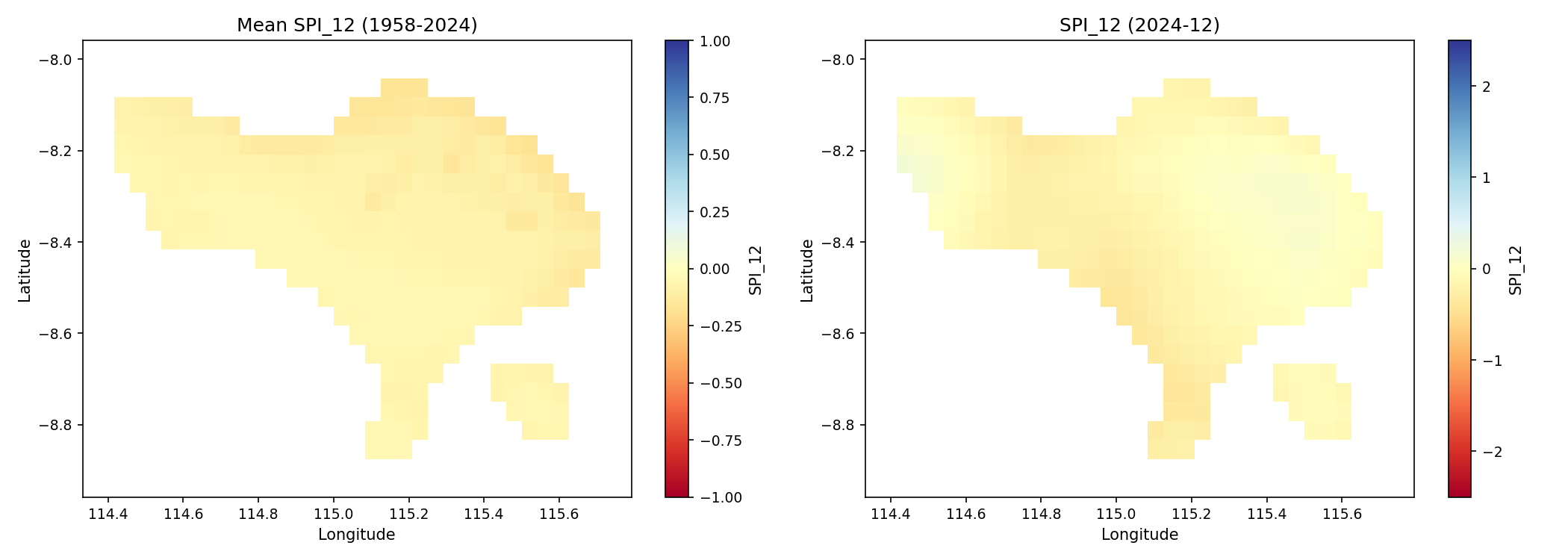
The map below shows the Bali test domain with SPI-12 values at selected time points. Ocean cells (white) are automatically masked during processing.
Climate Context
Understanding Bali’s climate helps interpret the validation results:
- Annual Rainfall: 1,888 mm/year averaged over the domain, varying from 1,160 mm/year at the driest cell to 2,737 at the wettest, and from 1,181 to 2,854 mm/year between the driest and wettest years
- Wet Season: November–March (67% of annual rainfall)
- Dry Season: April–October (can be severe during El Niño years)
- Temperature: Relatively stable year-round (24–26°C at lowlands), with cooler highlands
Major Drought Episodes in the Record:
The table below is computed from the test suite’s own SPI-12 (Gamma) output rather than quoted from elsewhere. An episode is a run of consecutive months whose domain-mean SPI-12 stays below -1.0; 21 such episodes occur in the 76-year record. The ten deepest:
tests/output/netcdf/spi_12_gamma.nc.
| Period | Months | Domain-mean peak | Driest single cell |
|---|---|---|---|
| Feb 1953 – Jan 1954 | 12 | -2.29 | -3.09 |
| Jul 1969 – Oct 1970 | 16 | -2.22 | -2.90 |
| Oct 1997 – Apr 1998 | 7 | -2.17 | -2.64 |
| Oct – Nov 1965 | 2 | -1.97 | -2.61 |
| Nov 2023 – Oct 2024 | 12 | -1.95 | -3.07 |
| Jan – Sep 1964 | 9 | -1.93 | -2.46 |
| Jul – Dec 1961 | 6 | -1.93 | -2.67 |
| Jan – Nov 2007 | 11 | -1.88 | -2.57 |
| Oct – Dec 1972 | 3 | -1.73 | -2.60 |
| Nov 2019 – Oct 2020 | 12 | -1.63 | -2.29 |
The 1997-98 episode is the well-documented strong El Niño drought and the package places it third deepest. Note two consequences of the dataset change: the deepest episode in the record, 1953-54, only appears because the record now starts in 1950, and the 1982-83 event listed in earlier versions of this page does not reach the -1.0 domain-mean threshold in TerraClimate v1.1 at all.
Domain-mean and single-cell peaks differ by roughly 0.5 to 1.1 index units because a drought is rarely uniform across the island. Quoting one where the other is meant is the easiest way to misread this table.
1. SPI Distribution Comparison
1.1 Multi-Scale SPI Comparison
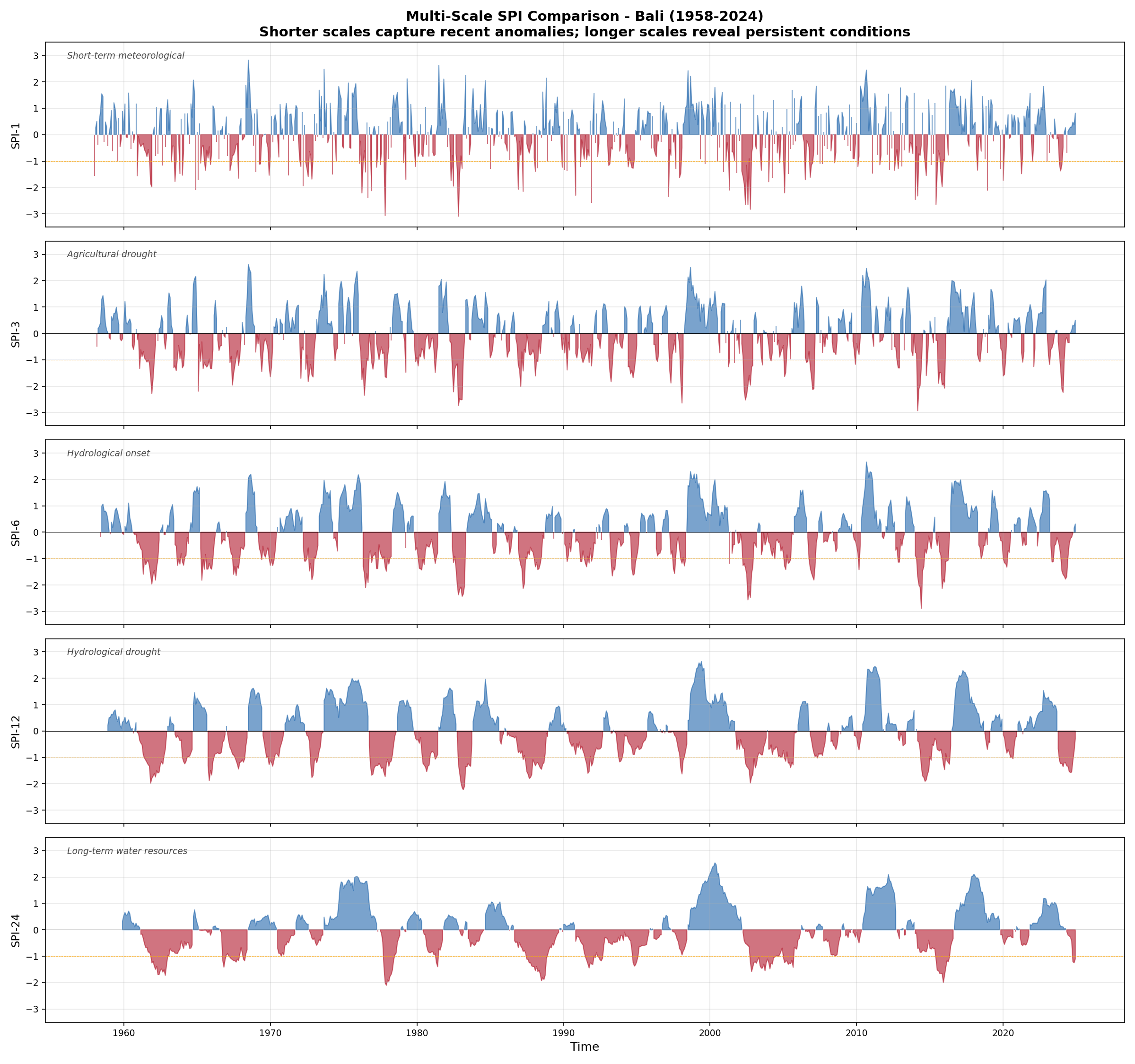
SPI at different accumulation periods captures drought signals at varying time scales. The multi-scale comparison shows how drought patterns evolve from short-term (SPI-1) to long-term (SPI-24) perspectives.
What to look for:
- SPI-1 shows high-frequency variability responding to monthly rainfall anomalies.
- SPI-3 smooths out noise while capturing seasonal drought patterns relevant to agriculture.
- SPI-12 and SPI-24 show persistent multi-year drought cycles useful for water resource management.
- The 1997-98 El Niño and 2015-16 drought events are visible across all scales.
1.2 Distribution Comparison
The SPI was computed with three probability distributions: Gamma (WMO standard), Pearson Type III, and Log-Logistic. All three produce highly consistent results.
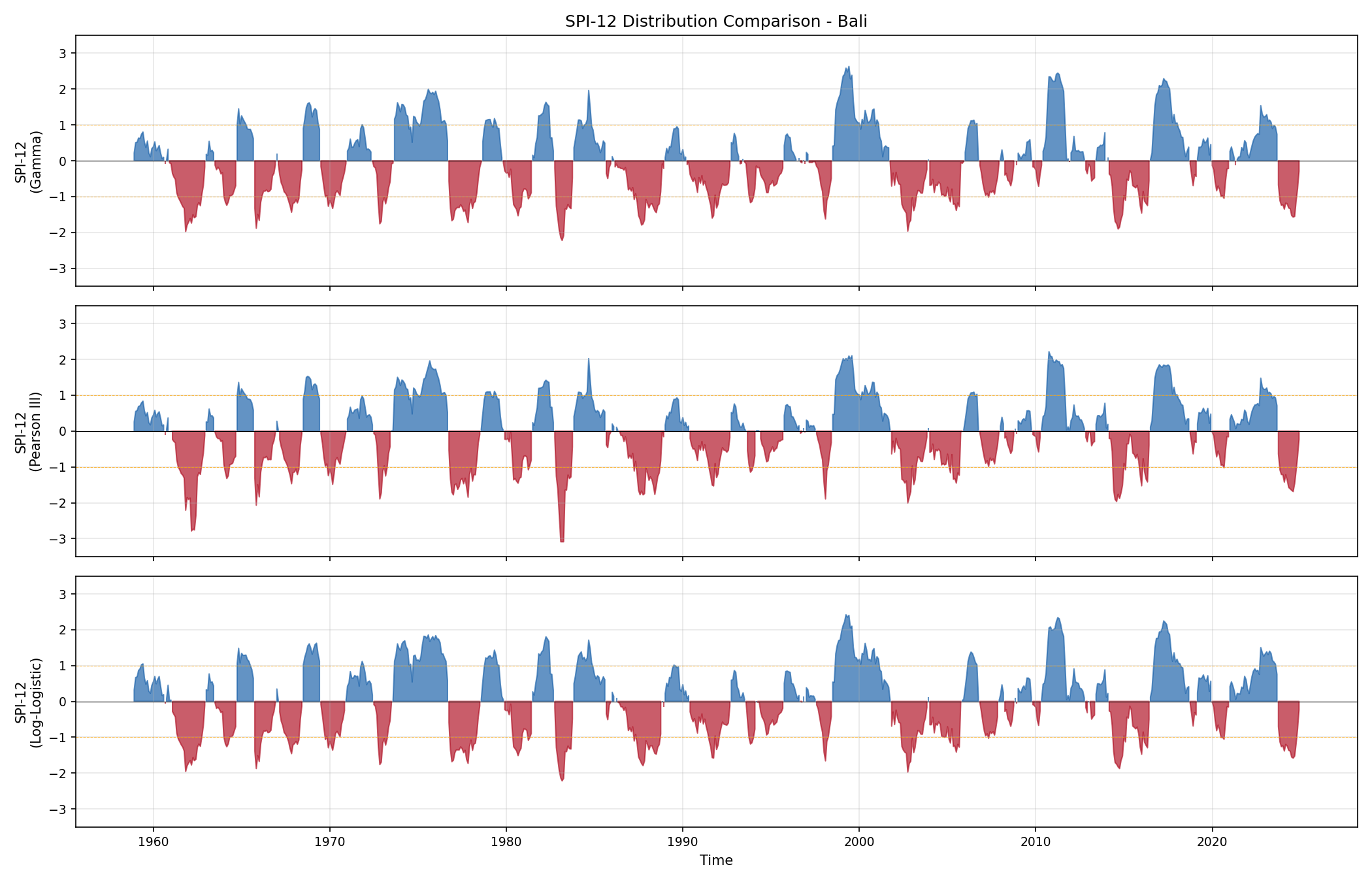
Cross-Distribution Correlations (SPI-12):
tests/output/reports/02_spi_calculation_report.txt.
| Distribution Pair | SPI-12 | SPI-3 |
|---|---|---|
| Gamma vs Pearson III | r = 0.9908 | r = 0.9867 |
| Gamma vs Log-Logistic | r = 0.9957 | r = 0.9899 |
| Pearson III vs Log-Logistic | r = 0.9910 | r = 0.9810 |
1.3 WMO Time Series Visualization
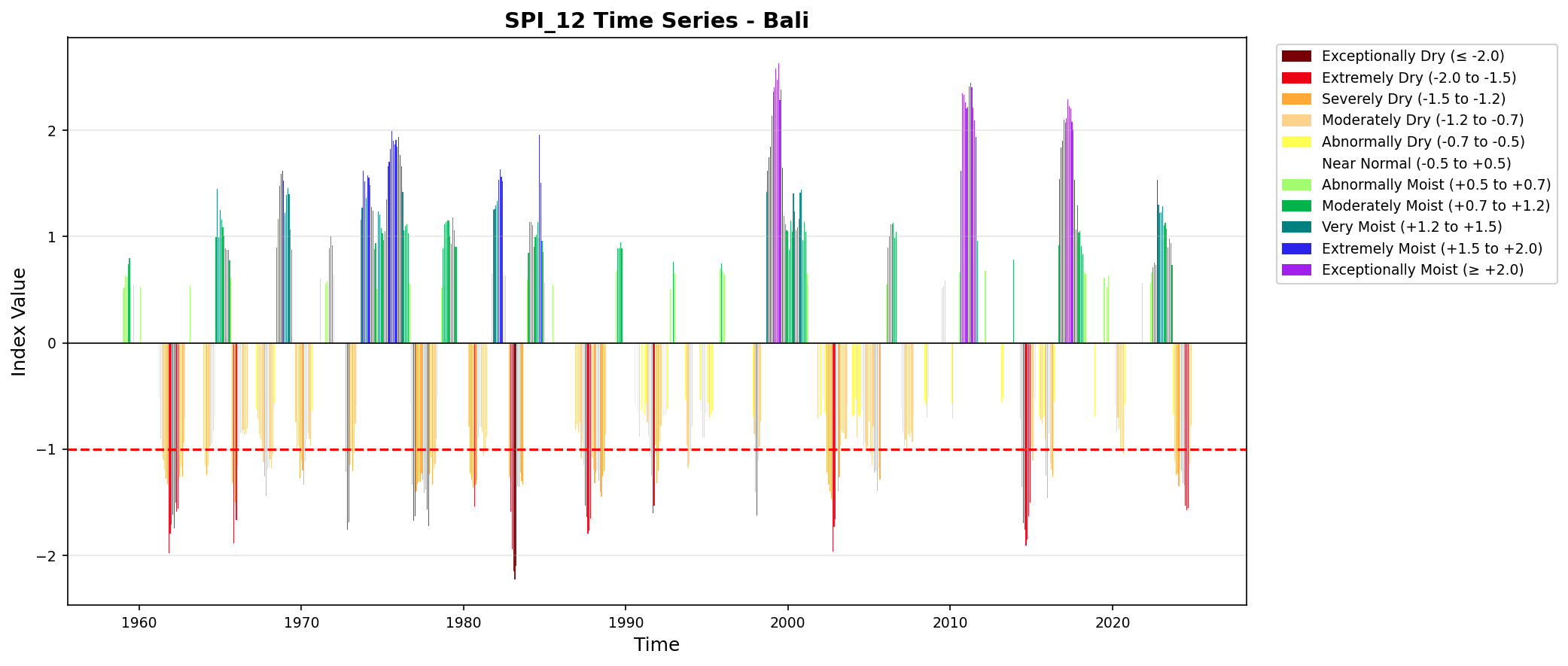
The plot_index() function produces standardized bar charts following WMO drought classification guidelines.
What to look for:
- The 11-category WMO color scheme correctly maps index values to severity classes.
- Major drought events (1997-98, 2015-16, 2019) are clearly visible.
- The time axis spans the full 76-year record with readable labels.
1.4 Spatial SPI Maps
Spatial maps show SPI-12 values across the entire Bali domain for selected time periods.
What to look for:
- Spatial patterns show physically consistent gradients across the island.
- Northern lowlands and southern highlands often show different drought intensities.
- Ocean cells are correctly masked as no-data.
2. SPEI Distribution Comparison
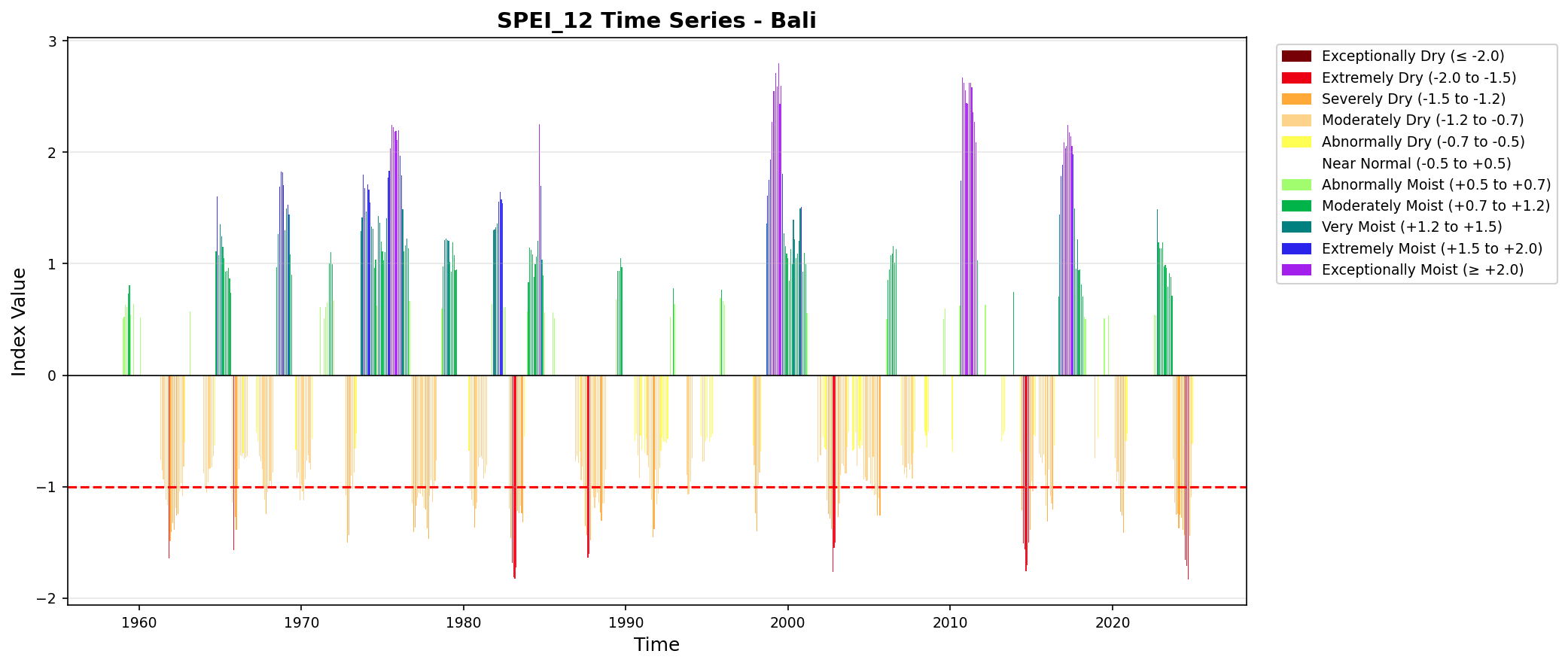
2.1 WMO Time Series
The Standardized Precipitation-Evapotranspiration Index (SPEI) incorporates both precipitation and potential evapotranspiration, making it sensitive to temperature-driven drought intensification.
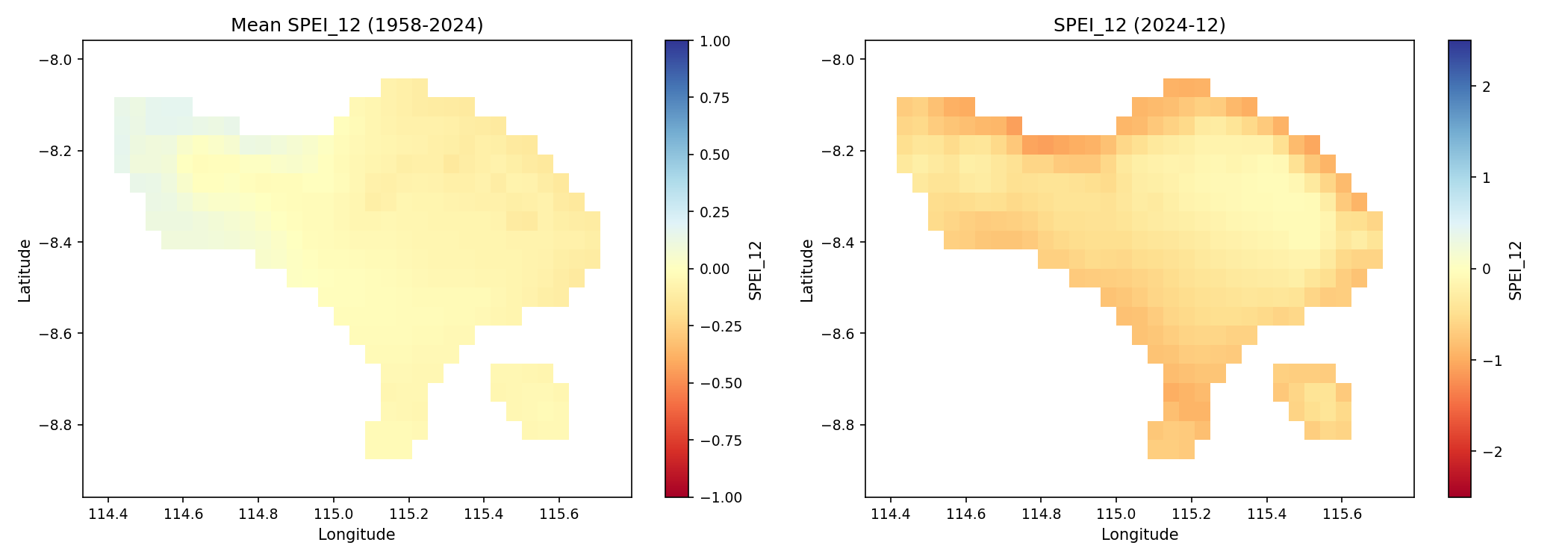
2.2 SPEI Spatial Maps
3. PET Method Comparison
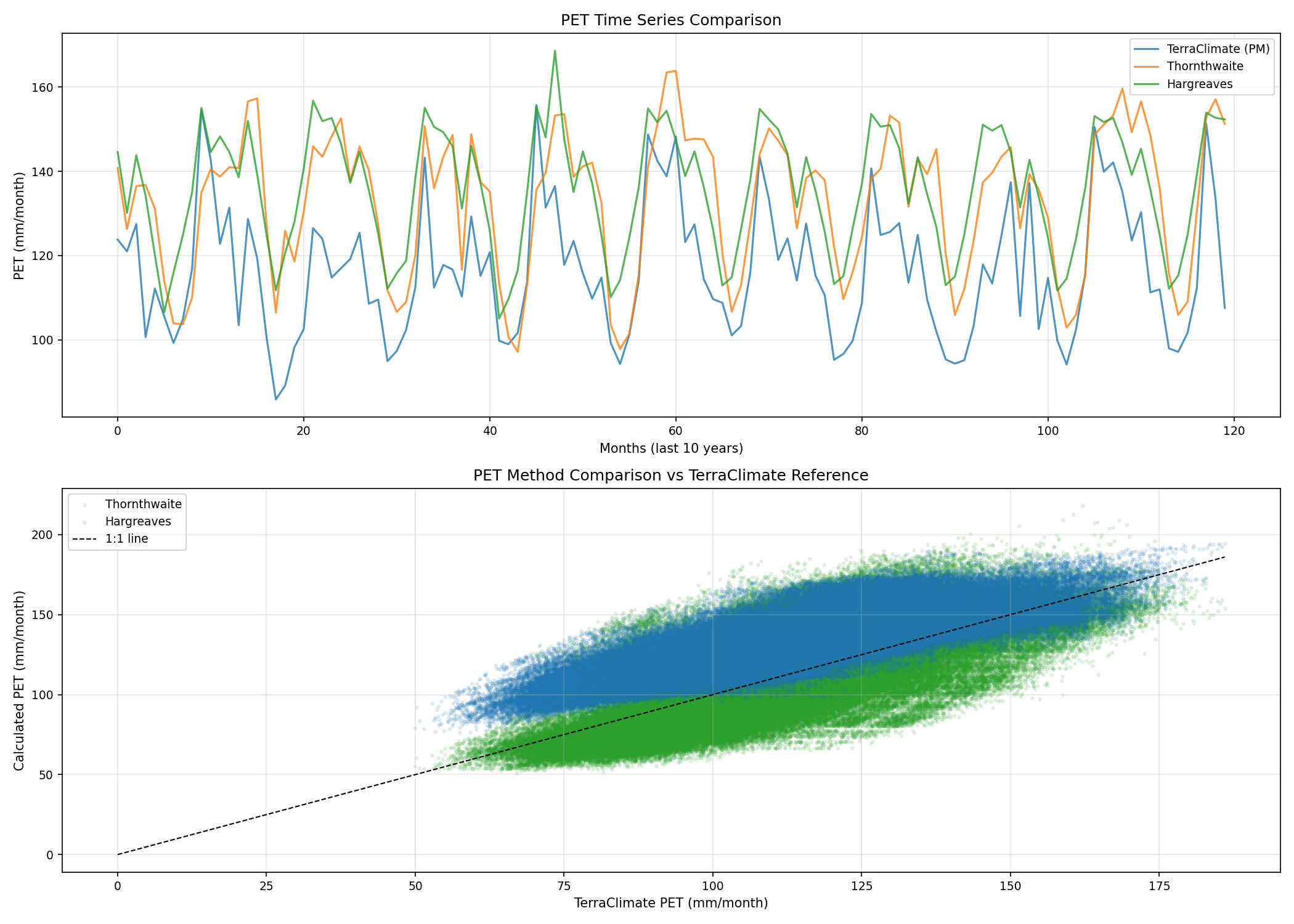
3.1 Three PET Methods
The package supports multiple PET calculation methods. Validation compares:
- TerraClimate PET (Penman-Monteith reference)
- Thornthwaite (temperature-only method)
- Hargreaves-Samani (temperature range method)
3.2 PET Method Summary
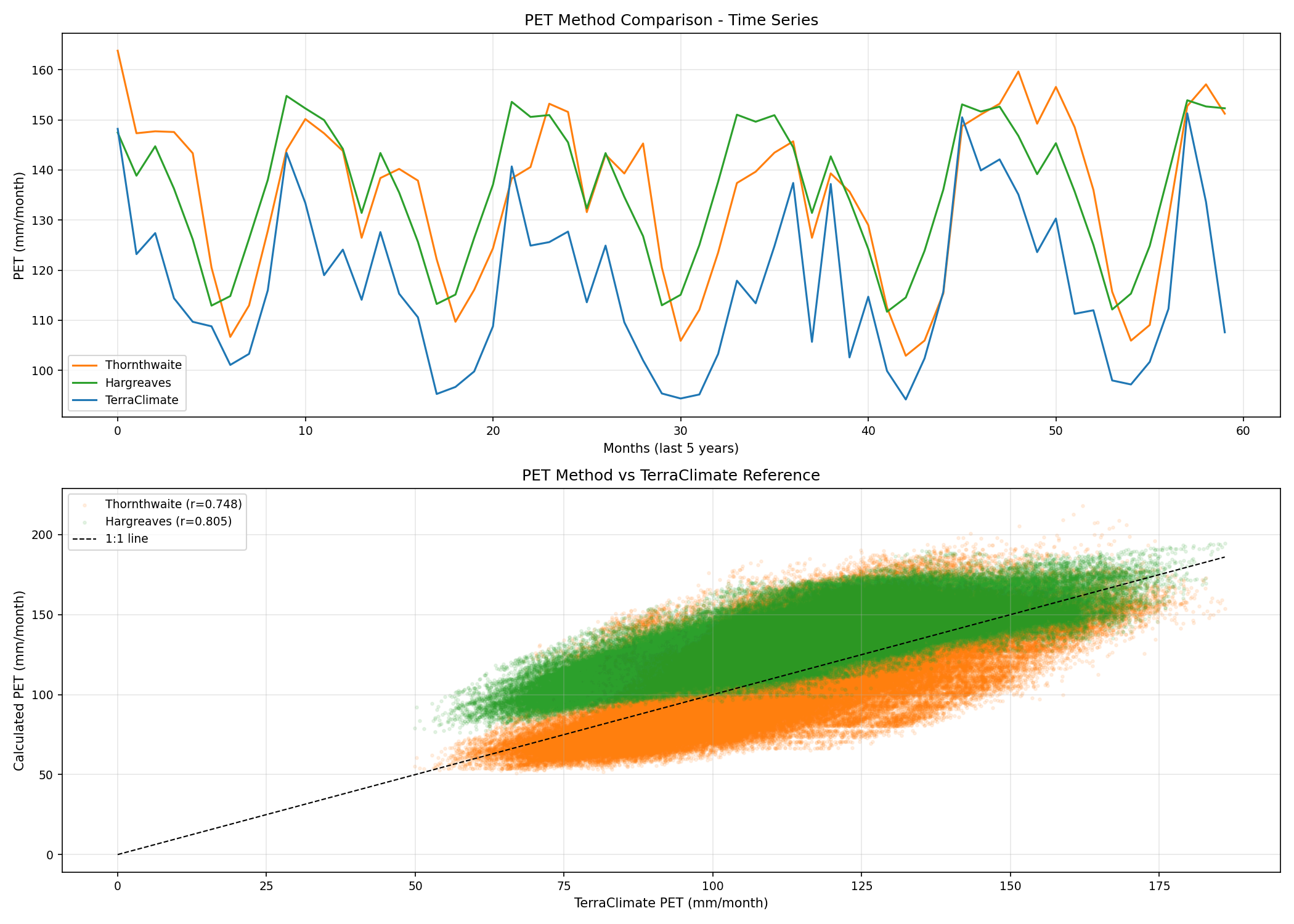
PET Method Statistics:
| PET Method | Mean (mm/month) | Std Dev | Correlation with Reference | RMSE | Bias |
|---|---|---|---|---|---|
| TerraClimate (reference) | 112.4 | 20.3 | — | — | — |
| Thornthwaite | 115.5 | 28.5 | r = 0.748 | 19.2 | -3.1 |
| Hargreaves | 132.1 | 16.9 | r = 0.805 | 23.1 | -19.7 |
Key findings:
- Hargreaves shows better correlation (r = 0.80) with the Penman-Monteith reference.
- Thornthwaite has lower bias but higher variance.
- For tropical regions like Bali, Hargreaves is recommended when Tmin/Tmax are available.
4. SPI vs SPEI Comparison
4.1 Time Series Comparison
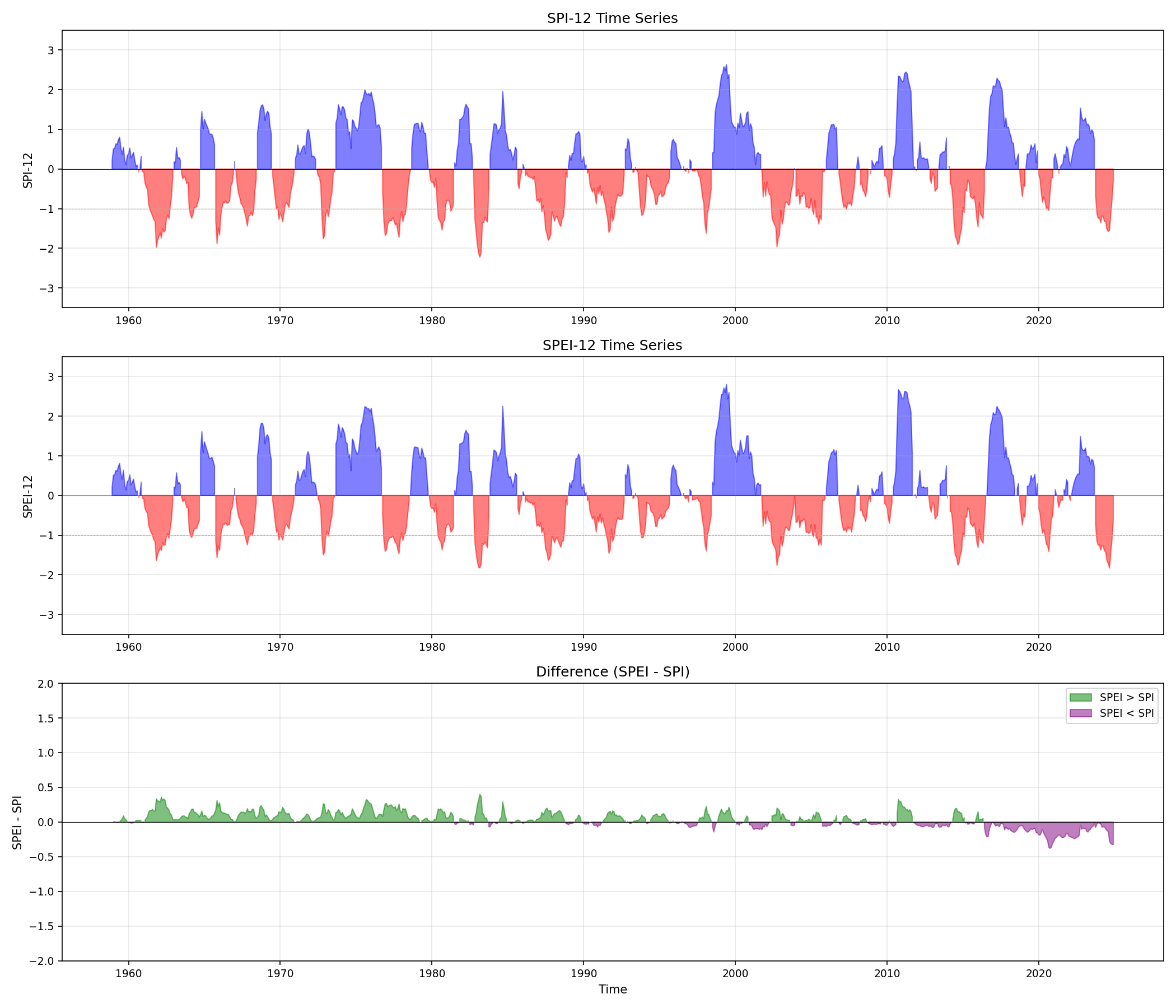
Direct comparison between SPI and SPEI reveals the impact of evaporative demand on drought assessment.
4.2 Scatter Analysis
4.3 Drought Area Comparison
SPI vs SPEI Statistics:
| Scale | Correlation | RMSE | Bias (SPI-SPEI) | Agreement Rate |
|---|---|---|---|---|
| 3-month | r = 0.965 | 0.263 | +0.026 | 94.7% |
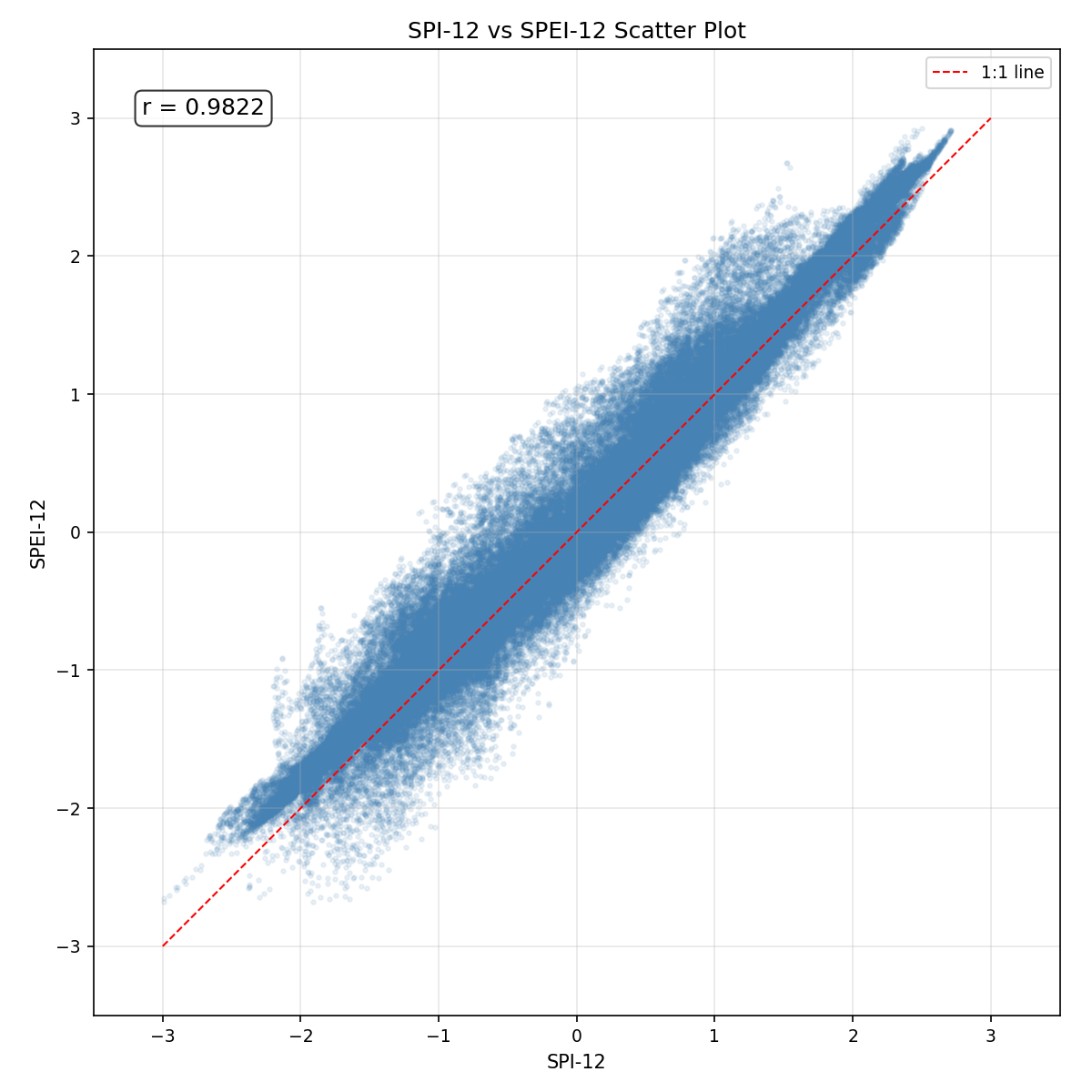
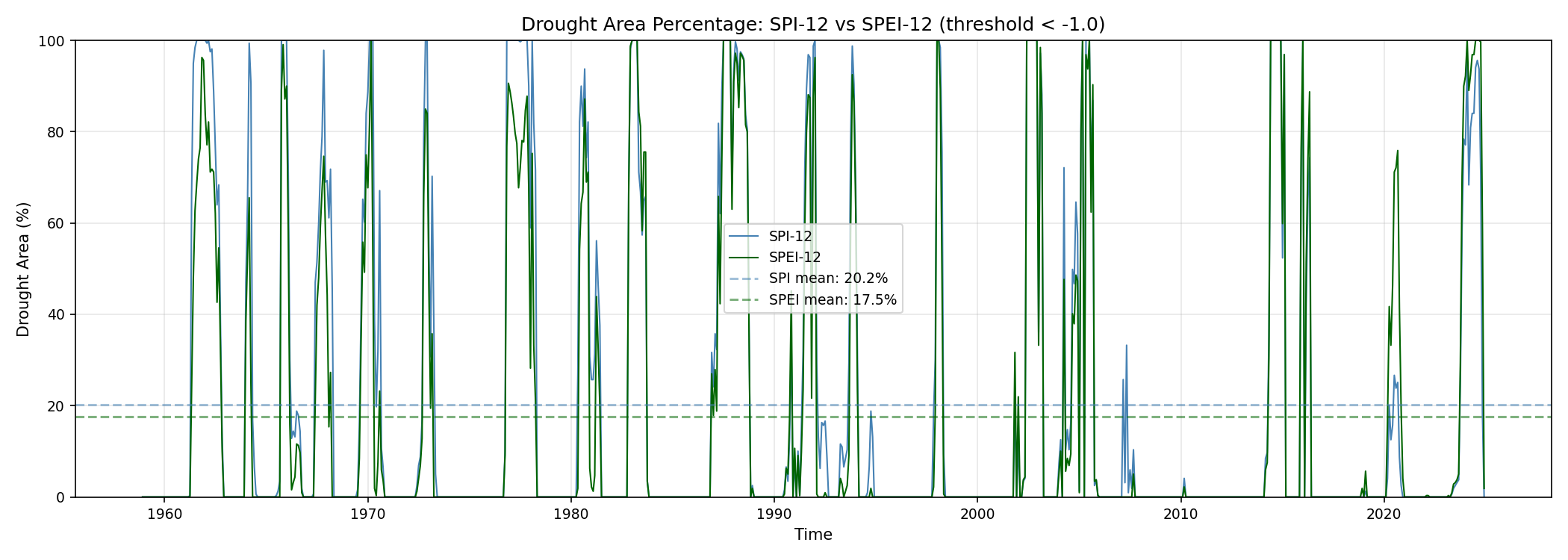
| 12-month | r = 0.982 | 0.195 | +0.054 | 95.6% |
5. Advanced Visualizations
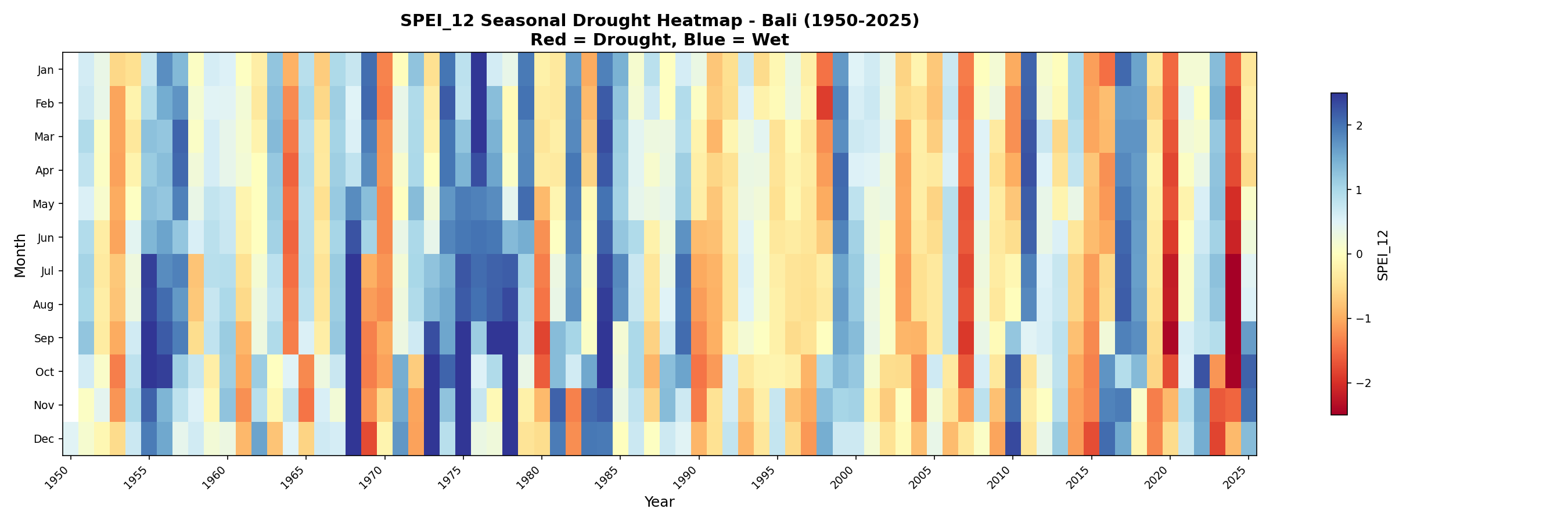
5.1 Seasonal Drought Heatmap
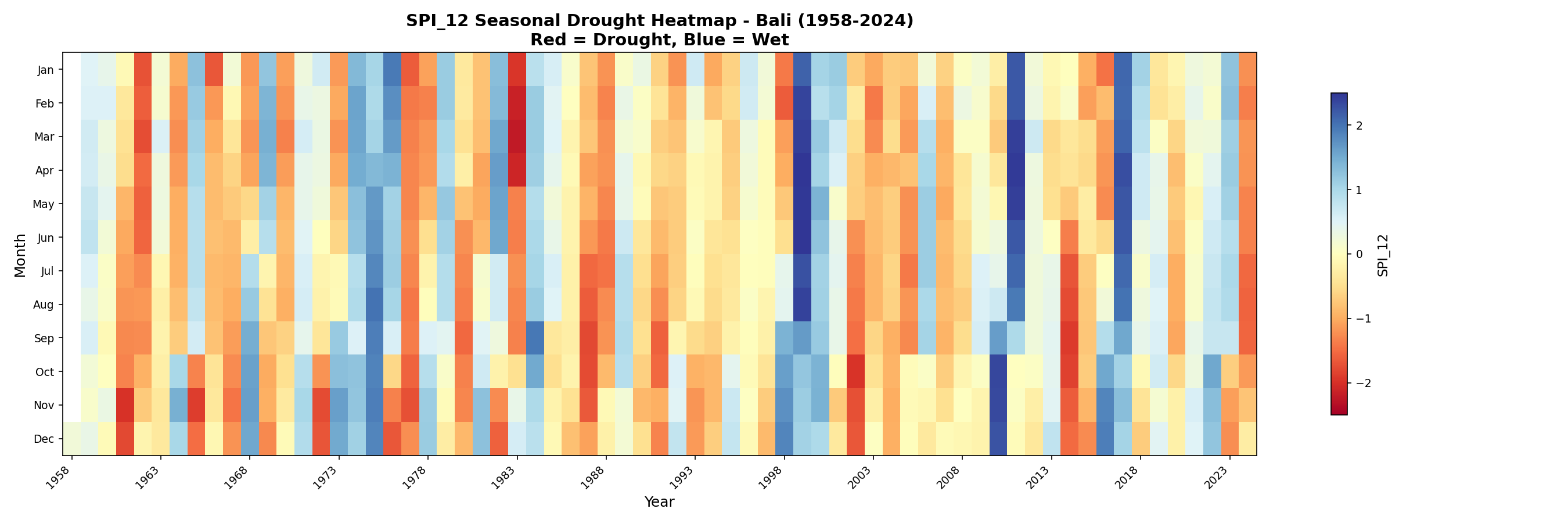
The seasonal heatmap reveals month-by-month drought patterns across years, useful for identifying seasonal drought tendencies.
What to look for:
- Persistent drought years appear as vertical red bands (e.g., 1997, 2015, 2019).
- Seasonal patterns may show if certain months are consistently drier.
- Multi-year drought cycles are visible as horizontal red streaks.
5.2 Historical Extreme Events
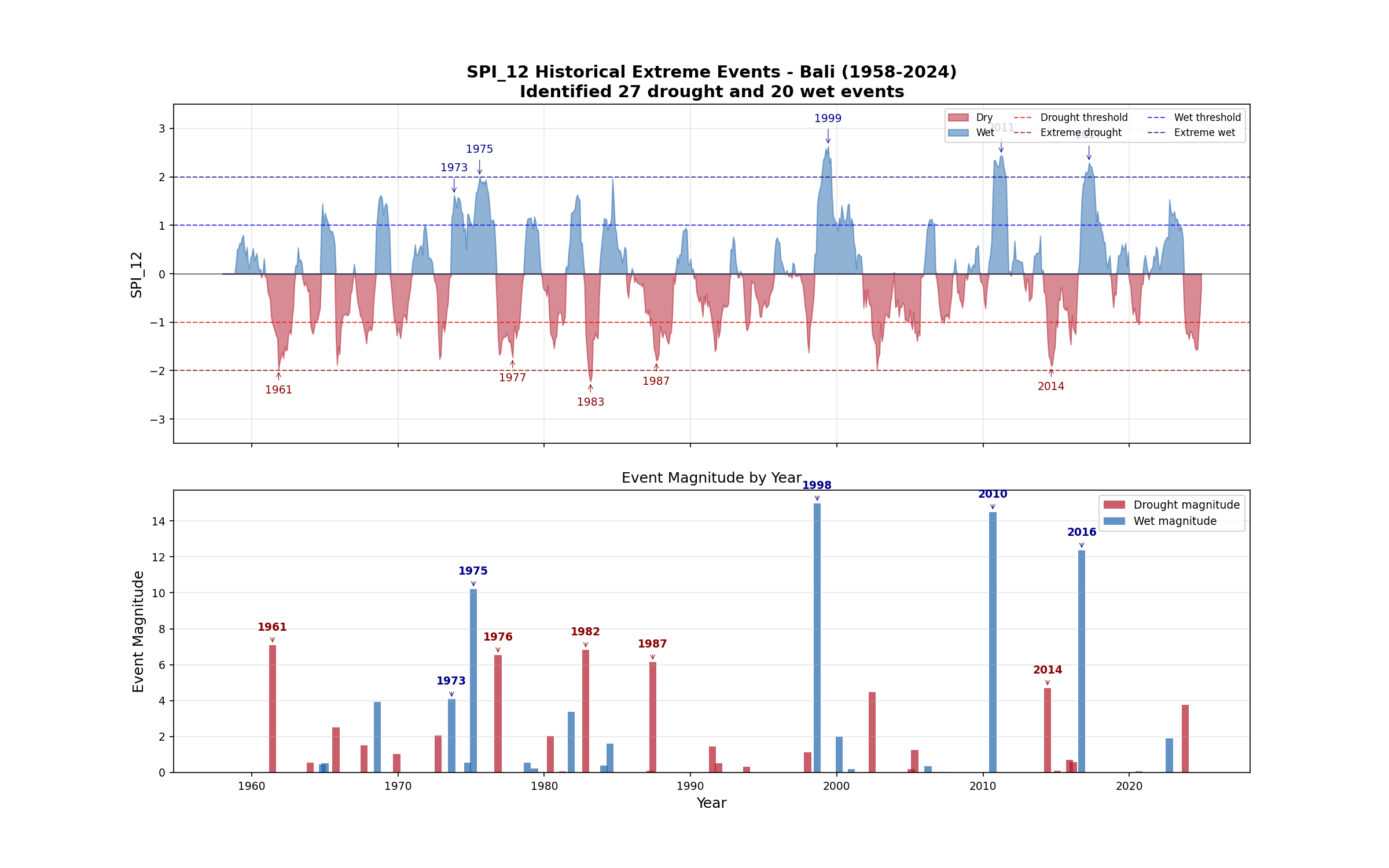
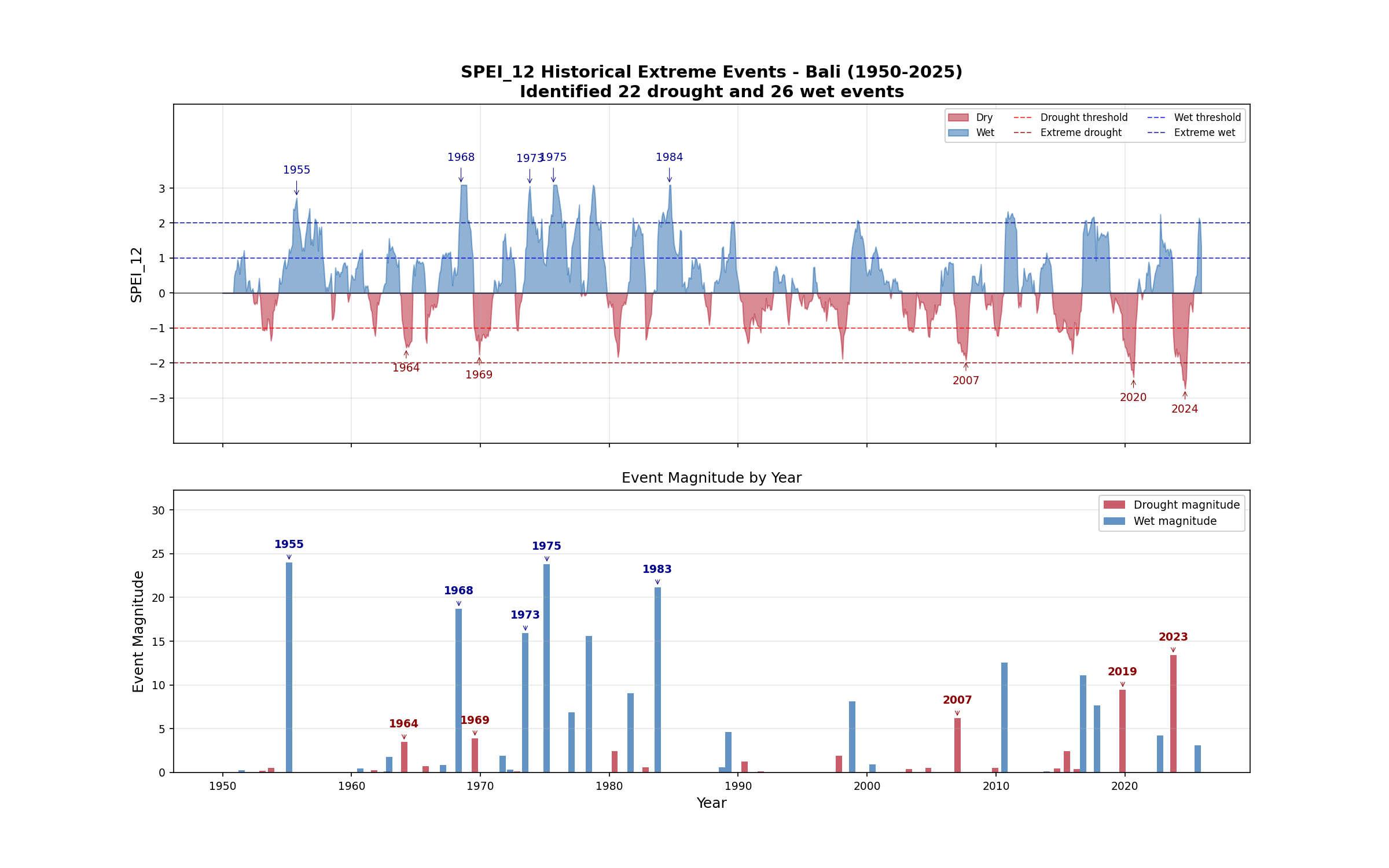
Run theory analysis identifies and characterizes historical drought and wet events.
What to look for:
- Major drought events are automatically identified using run theory (threshold = -1.0).
- Event magnitude (cumulative deficit) ranks the severity of each event.
- The bottom panel shows event magnitude by year for trend analysis.
5.3 Decadal Trend Analysis
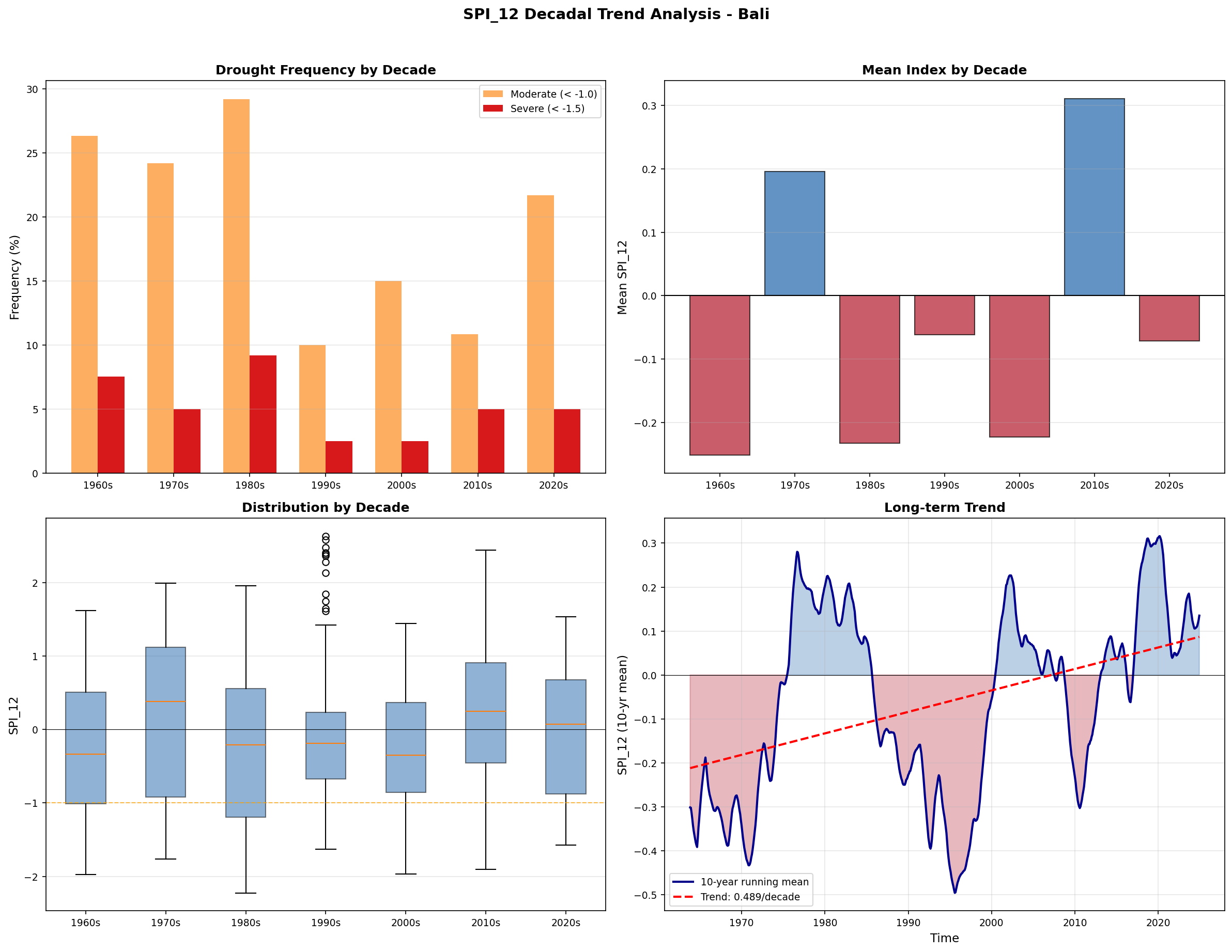
Long-term analysis reveals how drought frequency and intensity have changed over decades.
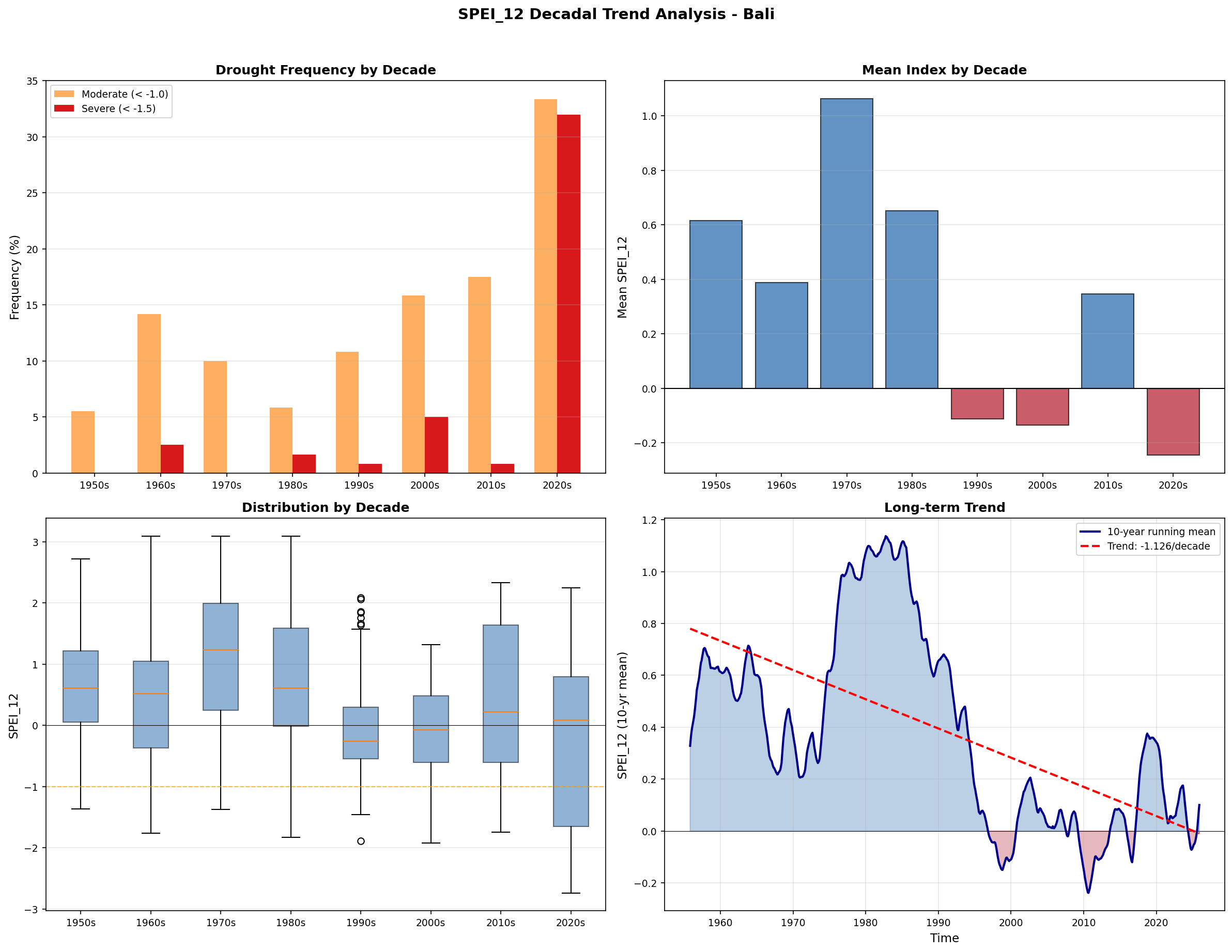
What to look for:
- Drought frequency panel shows percentage of drought months per decade.
- Boxplots reveal changes in drought variability across decades.
- Running mean and linear trend indicate long-term drying or wetting tendencies.
5.4 Exceedance Probability Plot
The exceedance probability plot provides risk assessment information for planning purposes.
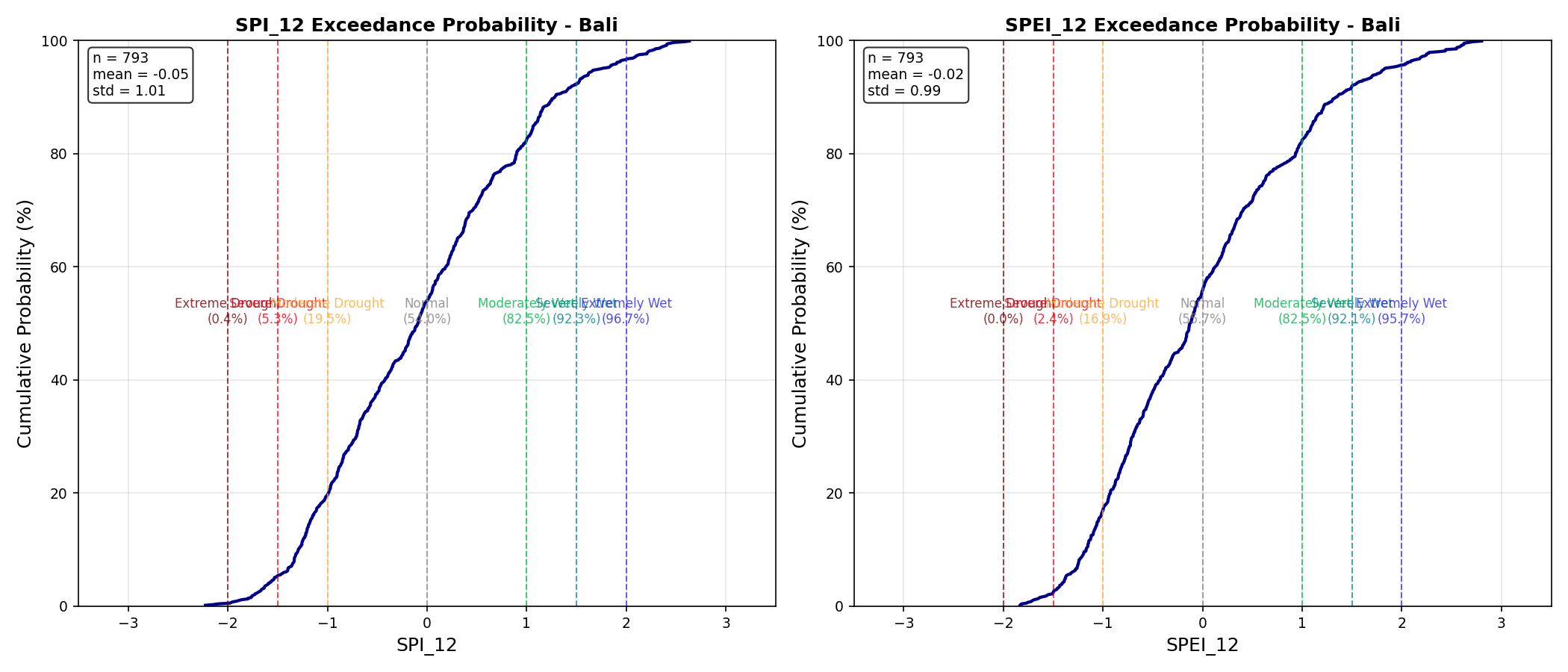
What to look for:
- The curve shows cumulative probability of exceeding each index value.
- Vertical lines mark key thresholds (moderate, severe, extreme drought).
- Return periods help translate index values into risk metrics.
5.5 Climate Stripes Visualization
Climate stripes provide an intuitive visual summary of drought conditions over the entire record.
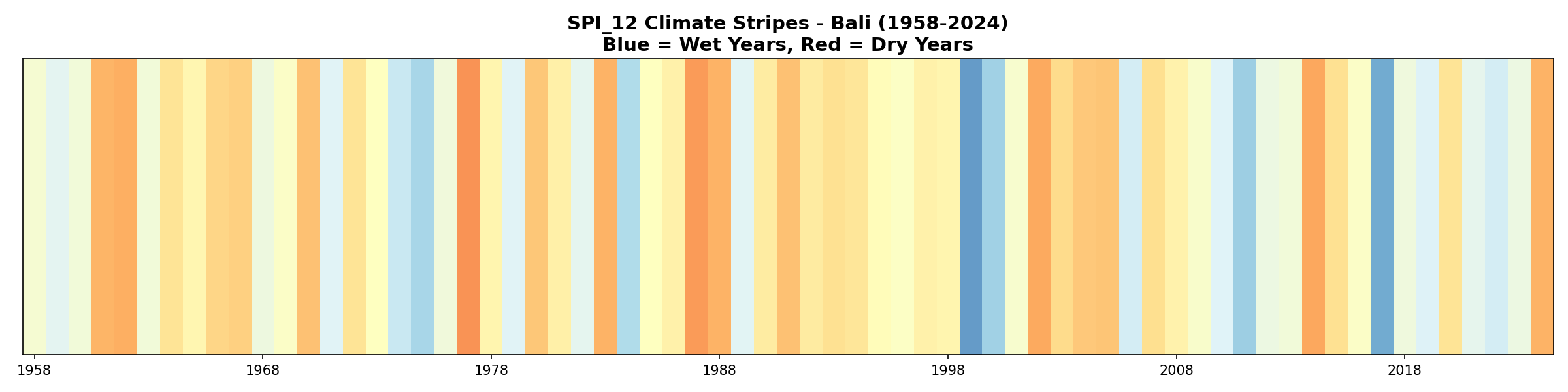
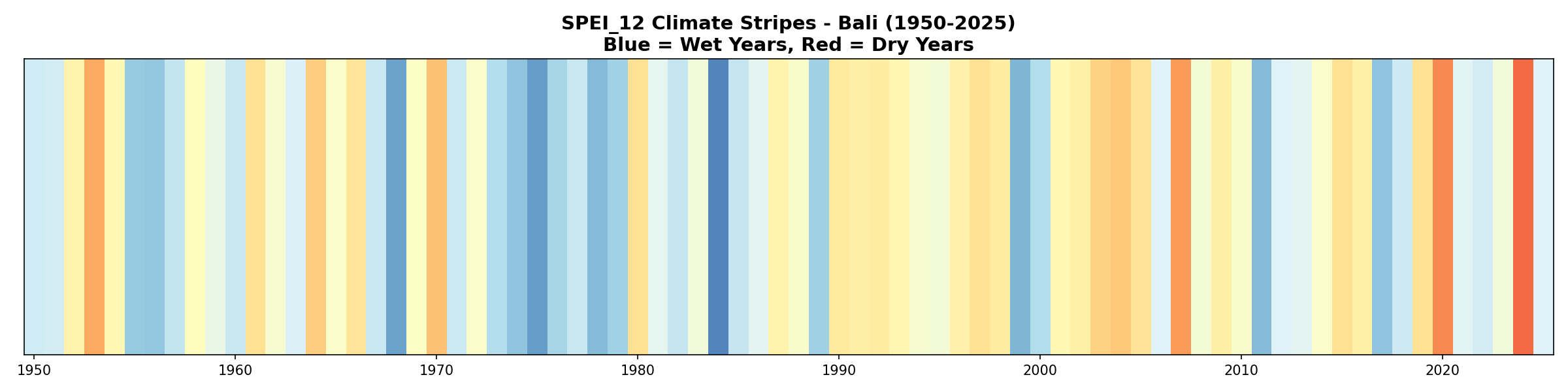
What to look for:
- Red stripes indicate drought years, blue stripes indicate wet years.
- Clustering of red stripes reveals multi-year drought periods.
- This visualization style (inspired by “warming stripes”) provides immediate visual impact.
6. Operational Mode: Parameter Persistence
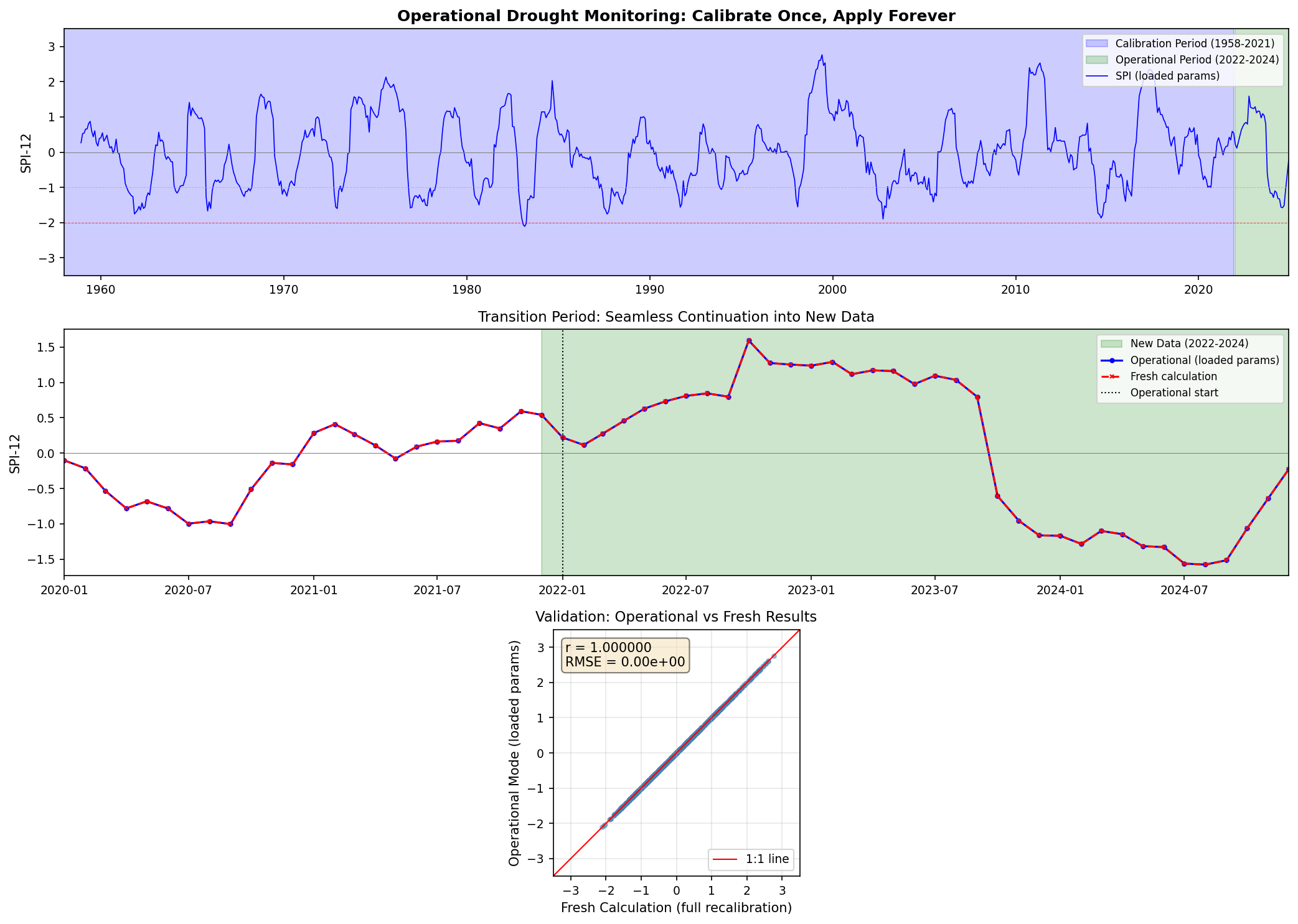
In real-world drought monitoring, you don’t recalibrate every time new data arrives. Instead, you establish a stable baseline period, save those distribution parameters, and apply them consistently to new observations. This ensures temporal consistency and makes drought assessments comparable over time.
The Workflow
- Calibration Phase: Calculate SPI/SPEI on historical data (1950-2021) and save fitted distribution parameters
- Operational Phase: Load saved parameters and apply to new data (2022-2025) without refitting
- Validation: Confirm operational results are identical to fresh calculations
Workflow Visualization
What to look for:
- The transition from calibration to operational period should be seamless.
- Results using loaded parameters match fresh calculations exactly (r = 1.0, max diff < 10⁻⁶).
- New drought/wet events in 2022-2025 are properly detected using historical parameters.
Distribution Parameters
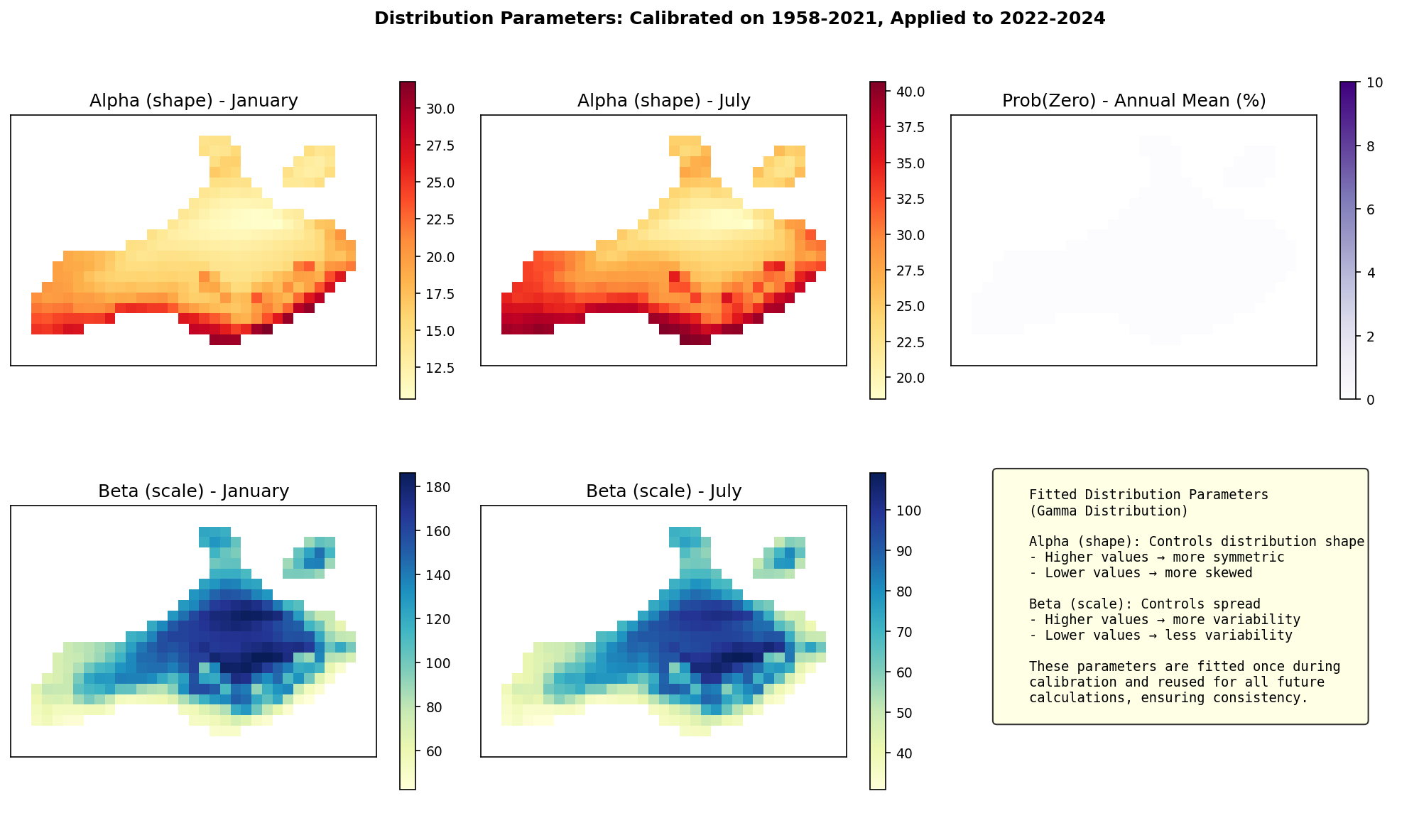
The fitted parameters are stored as spatial grids for each calendar month, allowing consistent application to new data:
Multi-Scale, Multi-Distribution Validation
The operational mode was validated across multiple configurations:
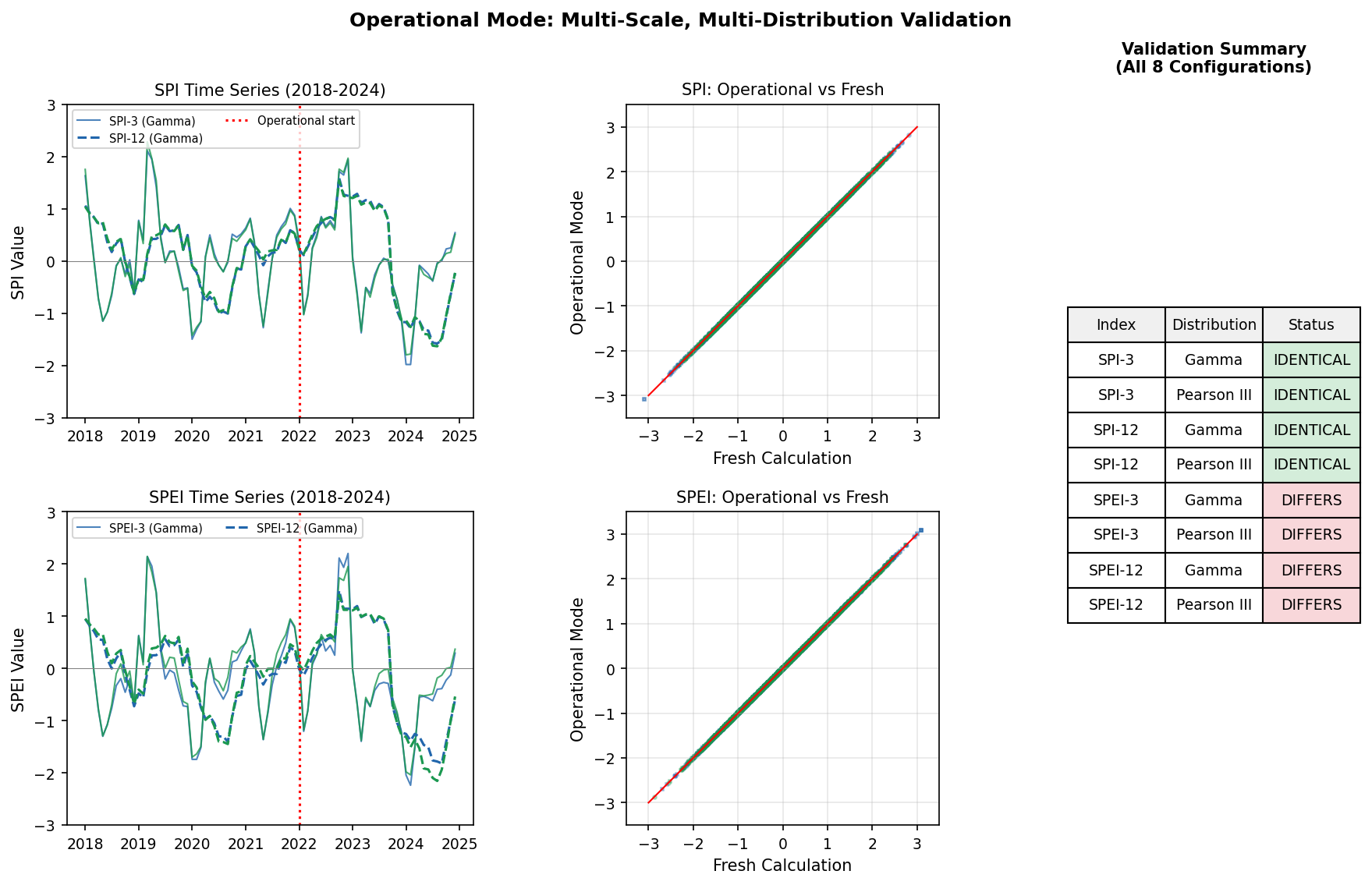
Validation Results:
| Configuration | Correlation | Max Difference | Status |
|---|---|---|---|
| SPI-3 (Gamma) | 1.000000 | 0.00e+00 | IDENTICAL |
| SPI-3 (Pearson III) | 1.000000 | 0.00e+00 | IDENTICAL |
| SPI-12 (Gamma) | 1.000000 | 0.00e+00 | IDENTICAL |
| SPI-12 (Pearson III) | 1.000000 | 0.00e+00 | IDENTICAL |
| SPEI-3 (Gamma) | 1.000000 | 0.00e+00 | IDENTICAL |
| SPEI-3 (Pearson III) | 1.000000 | 0.00e+00 | IDENTICAL |
| SPEI-12 (Gamma) | 1.000000 | 0.00e+00 | IDENTICAL |
| SPEI-12 (Pearson III) | 1.000000 | 0.00e+00 | IDENTICAL |
Usage Example
from indices import spi, save_fitting_params, load_fitting_params

# === CALIBRATION PHASE (run once) ===
# Calculate SPI and get fitted parameters
spi_12, params = spi(
    historical_precip,  # 1950-2021
    scale=12,
    calibration_start_year=1991,
    calibration_end_year=2020,
    return_params=True
)

# Save parameters for future use
save_fitting_params(
    params, 'spi_12_params.nc',
    scale=12, periodicity='monthly',
    calibration_start_year=1991,
    calibration_end_year=2020
)

# === OPERATIONAL PHASE (run monthly/as new data arrives) ===
# Load saved parameters
params = load_fitting_params('spi_12_params.nc', scale=12, periodicity='monthly')

# Apply to new data without refitting
spi_12_new = spi(
    new_precip,  # 2022-2025 (or any period)
    scale=12,
    fitting_params=params  # Uses pre-computed parameters
)
This workflow is essential for:
- Operational drought bulletins: Maintain consistency across monthly updates
- Climate services: Ensure comparability of drought assessments over time
- Near-real-time monitoring: Avoid expensive recalibration with each new observation
7. Validation Summary
Test Suite Results
The test suite consists of 7 structured test modules that comprehensively validate the package:
| Test Script | Status | Time | Description |
|---|---|---|---|
01_data_quality.py |
PASS | 14.6s | Data loading, quality checks, readiness assessment |
02_spi_calculation.py |
PASS | 224.7s | SPI-3, SPI-12 with Gamma, Pearson III, Log-Logistic |
03_pet_comparison.py |
PASS | 17.8s | Thornthwaite vs Hargreaves vs TerraClimate PET |
04_spei_calculation.py |
PASS | 823.6s | SPEI with pre-computed PET, Thornthwaite, Hargreaves |
05_spi_spei_comparison.py |
PASS | 17.7s | SPI vs SPEI correlation, drought detection comparison |
06_visualization.py |
PASS | 147.7s | 25 visualization outputs including advanced analytics |
07_operational_mode.py |
PASS | ~120s | Parameter save/load, operational consistency validation |
Output Summary
The test suite generates comprehensive outputs:
- NetCDF files: 34 files (SPI/SPEI indices + saved parameters)
- Plot files: 28 visualizations (time series, spatial maps, advanced analytics, operational mode)
- Report files: 6 text reports with detailed statistics
Distribution Fitting Quality
| Distribution | Fitting Method | SPI Quality | SPEI Quality |
|---|---|---|---|
| Gamma | Method of Moments | Excellent | Excellent |
| Pearson III | Method of Moments | Excellent | Excellent |
| Log-Logistic | Maximum Likelihood | Excellent | Excellent |
Key Findings
All three distributions produce consistent results — correlation > 0.98 between any pair of distributions for both SPI and SPEI.
Hargreaves PET outperforms Thornthwaite when validated against Penman-Monteith reference (r = 0.805 vs r = 0.748 for Bali).
SPI and SPEI are highly correlated (r > 0.96), with 94-96% agreement in drought detection.
Multi-scale analysis reveals different drought patterns: meteorological (SPI-1), agricultural (SPI-3), hydrological (SPI-6/12), and socioeconomic (SPI-24).
Run theory event detection successfully identifies major historical droughts including 1997-98 El Niño, 2015-16, and 2019 events.
Decadal trends can be analyzed to assess long-term changes in drought frequency and intensity.
Advanced visualizations (seasonal heatmaps, climate stripes, exceedance probability) provide intuitive tools for communication and risk assessment.
Operational mode works perfectly — parameter save/load produces results identical to fresh calculations across all configurations (SPI/SPEI × scales × distributions).
See Also
- Probability Distributions - Distribution selection and fitting methods
- Methodology - Scientific background
- Implementation Details - Code architecture
- API Reference - Function documentation
- User Guides - Practical usage